Your Own Face or a Stock AI Avatar? Choosing the Best AI Video Avatar for Sales
By Carlos Agüero, who builds AI video and outreach automation tools for B2B sales teams at Potion, TargetGrid.ai and Skale.email. Updated October 22, 2026.
The best AI video avatar for sales is usually a clone of the rep's own face, voice and gestures, not a stock avatar, because buyers trust real people more and outreach depends on that trust. Your Sales Development Representatives (SDRs) can record once and scale.
Plain-text cold email gets ignored, and manual video caps a rep at a few dozen prospects a day. Avatar video promises a way out. But 36% of consumers say AI-generated videos lower their trust in a brand (Animoto, 2026), though that sample is consumers, not B2B buyers. This guide compares stock avatars, own-face clones and real recordings, then covers analytics, onboarding and disclosure.
Key Takeaways
An own-face AI clone keeps the sender's real identity at scale, which makes it the safer default for VP-level outreach than a stock avatar.
Sales-engagement avatar services differ from training avatar services in CRM triggers, sequence integrations, landing pages and per-prospect analytics.
Before buying any AI avatar tool, ask for view rate, watch time and CTA clicks for one named prospect in a live demo.
EU AI Act Article 50 has applied since 2 August 2026, so disclose AI video to EU prospects and get legal review.
Stock avatar vs own-face clone: how do the three options compare?
Own-face digital twin, stock AI avatar and real recording with a cloned voice are the three ways to put video into sales outreach. A stock avatar is fastest but borrows a stranger's face. An own-face twin keeps the rep's identity at scale. Consumers trust videos featuring real people at 77.9% (Animoto, 2026).
Three blank white portrait frames on a studio wall, one with a pink outline
A stock AI avatar is a pre-built synthetic presenter that anyone can license, not a likeness of your own rep. A digital twin is an AI model trained on a rep's own footage that reproduces their face, voice and gestures. A voice clone is a synthetic copy of a person's voice that can read new scripts.
Option
Whose face and voice
Scales to many prospects
Main trust risk
Best fit
Stock AI avatar
A licensed stranger
Yes
Prospect sees a generic presenter, not a person they could meet
Training, internal explainers
Own-face digital twin
The rep's own
Yes
Glitchy lip-sync or flat expressions
Bulk 1:1 outbound
Real recording, cloned voice, dynamic background
The rep's real face
Partly
Voice or background mismatch
Smaller, high-value lists
Animoto's CEO summed up the consumer side in its 2026 survey: "The data's clear: consumers are curious about AI, but confident in humans." (Beth Forester, StudyFinds, 2026). That sample is consumers, not B2B buyers, so treat it as directional.
Which AI avatar services are built for sales engagement rather than training videos?
Sales-engagement AI avatar services are built around outreach mechanics: per-prospect personalization from a CSV or Customer Relationship Management (CRM) trigger, sequence integrations, hosted landing pages and viewer analytics. Training avatar services are built around scripted, one-to-many explainer content. Salesforce reports 87% of sales organizations already use some form of AI (Salesforce, 2026), so the question is fit, not adoption.
Two wooden sorting trays on a desk, one holding sales folders and one holding training binders
Use this checklist to sort any shortlist:
Capability
Sales-engagement avatar service
Training or explainer avatar service
Presenter
Clone of the sending rep
Stock library of presenters
Bulk personalization
CSV upload or CRM trigger
Usually one script per video
Sequence integrations
Native links to your sales engagement stack (confirm which tools the vendor supports)
Rarely the focus
Delivery
GIF preview linking to a landing page
File export or embed
Per-prospect analytics
Needed, verify in demo
Usually aggregate views
A dynamic screen recording is a screen capture whose background changes per prospect, such as showing the prospect's own website. It is one of the clearest dividing lines between outreach tools and explainer tools. For more shortlists, see video prospecting tools for SDR teams and video messaging software for sales teams.
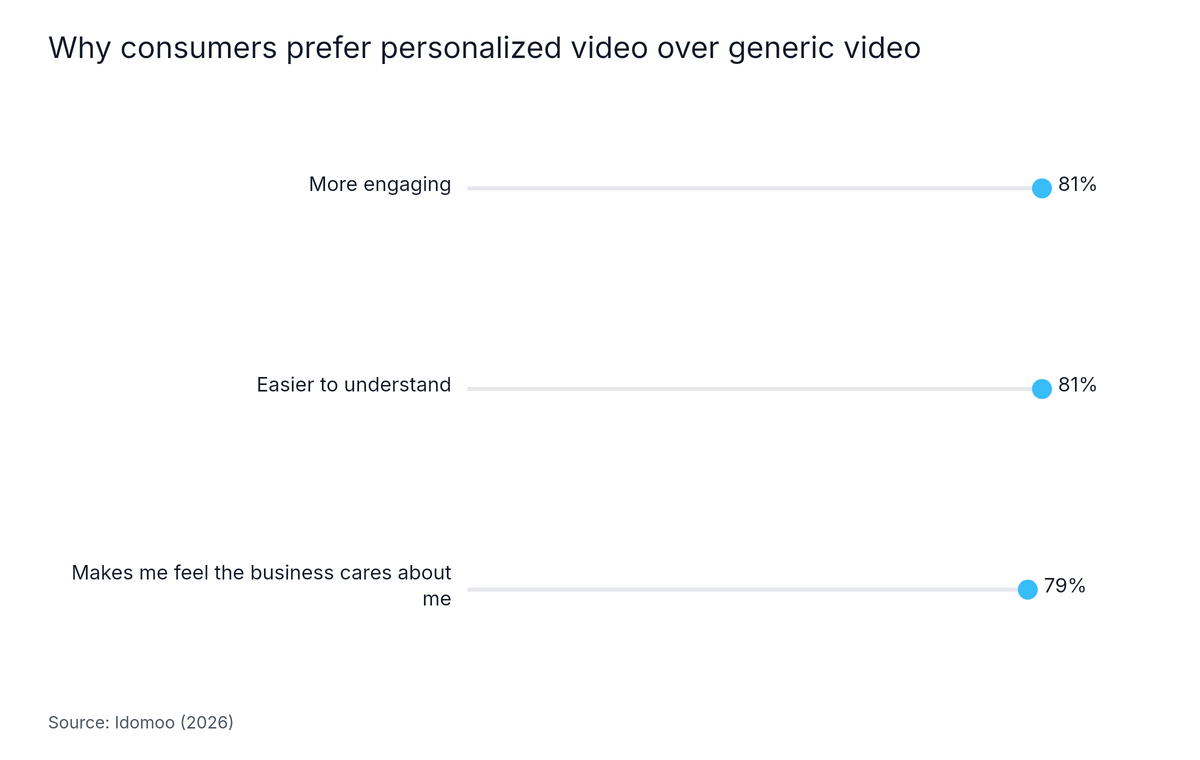
Why personalise at all? In its 2026 study, Idomoo found 74% of consumers want AI videos from brands, up from 65% a year earlier, and they prefer personalized to generic video 4 to 1 (Idomoo, 2026). Idomoo sells personalized video, so read it as directional. In the same study, 81% said personalized video is more engaging, 81% said it is easier to understand and 79% said it makes them feel the business cares (Idomoo, 2026).
Lollipop chart: Why consumers prefer personalized video over generic video. Highest: More engaging at 81%.
Our data: Potion's GrowPronto case study reports 45 meetings booked and 7 accounts closed. This is Potion's own customer result, not independent research.
No independent benchmark compares reply rates for avatar video, real-rep video and text. Treat any vendor reply-rate figure as a claim to test in your own pilot.
Will an AI avatar cost you trust with VP-level buyers?
A realistic own-face clone is the safer choice for VP-level prospects, because realism and a real identity both support trust. A peer-reviewed experiment with 491 participants found more realistic AI avatars were rated more trustworthy than cartoonish ones (Journal of Science Communication, 2025). Flawed expressions still reduced perceived authenticity, so quality checks matter.
A handshake between two business people across a conference table in warm light
The lead author said: "With our findings, we could not find a descent into the uncanny valley with a higher degree of realism, at least in our conditions." (Jasmin Baake, EurekAlert, 2025). The study used German science videos, not sales, so it supports realism, not a guaranteed reply rate.
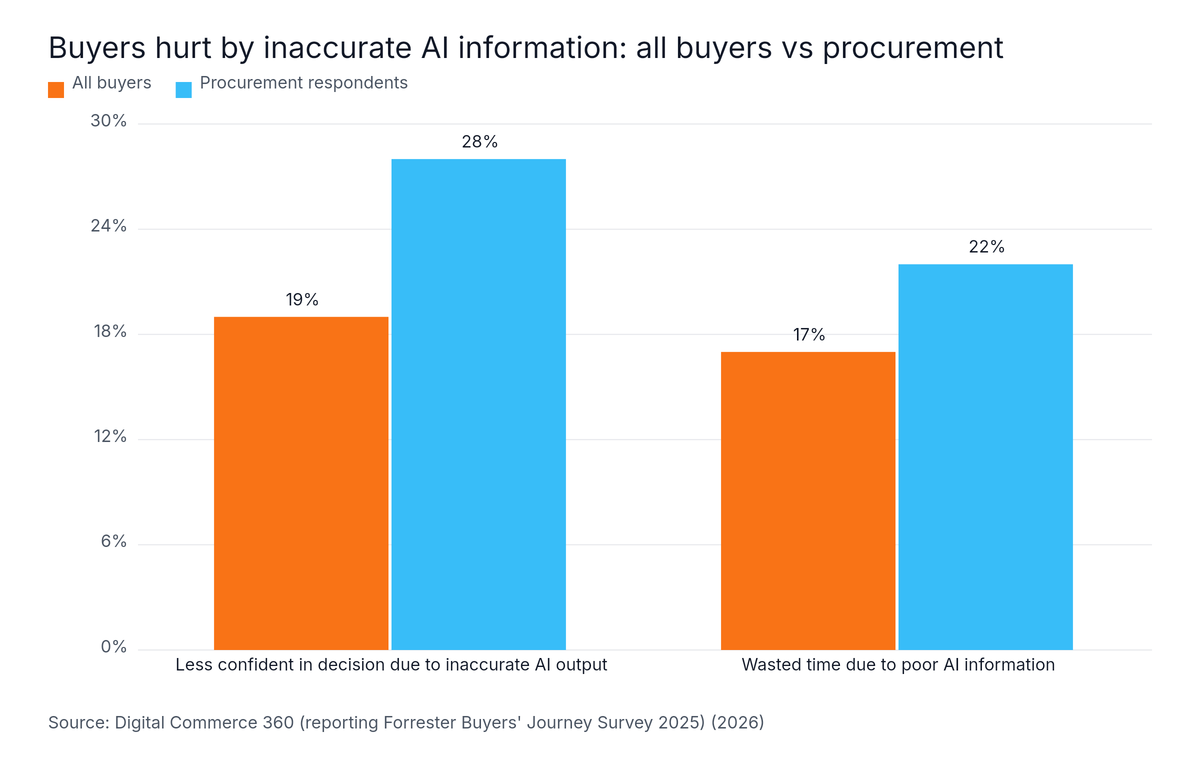
Senior buyers are also warier of AI material. In Forrester's 2025 Buyers' Journey Survey, procurement buyers were more likely than all buyers to say inaccurate AI output left them less confident (28% vs 19%) and that poor AI information wasted their time (22% vs 17%) (Digital Commerce 360, reporting Forrester, 2026).
Grouped Bar chart: Buyers hurt by inaccurate AI information: all buyers vs procurement. Highest: Less confident in decision due to inaccurate AI output at 19%.
Use an own-face clone for 1:1 outbound to named accounts.
Use a real recording with a dynamic screen background for your top-tier targets.
Keep stock avatars for training and internal content.
Run a 50-account pilot against a human-recorded control and review lip-sync, voice and gestures before scaling.
Forrester warned in 2025 that "Failure to ensure transparency could expose companies to both legal risk and customer mistrust." (Forrester, Digital Commerce 360, 2025). Its Predictions 2027, published this week, add: "Five Fortune 500 companies will apologize for AI content that damages customer trust." (Forrester, 2026). For video examples that got replies, see these prospecting examples.
Which AI avatar tools show view rate, watch time and CTA clicks per prospect?
AI avatar tools for sales should report, per prospect, whether the video was opened, how much was watched and whether the call-to-action (CTA) button was clicked. Buyers scrutinise AI content: 94% fact-check it (HG Insights, 2026, vendor research). Verify each metric for a named contact in a live demo.
Metric
What to ask the vendor to show
Why it matters
View rate
Opens per named contact, not just totals
Shows whether the preview and subject line work
Watch time
Percent watched per prospect
Separates curiosity from real interest
CTA clicks
Clicks on calendar or button per prospect
Links video to booked meetings
CRM sync
Events written back to your CRM
Lets managers report on pipeline
The HG Insights figure comes from vendor research whose sample is unconfirmed, so read it as directional. The point holds either way: if buyers check AI content, you need to see who watched what.
Hosted video landing pages are what usually make per-prospect tracking possible, because the click and the watch happen on a page the vendor controls. Potion, for example, lists custom branded video pages with calendar embeds and CTA buttons among its features. Confirm its reporting, and any other vendor's, in a demo. See personalized videos at scale for how the workflow fits a sequence.
Do you have to disclose an AI avatar in sales video?
Disclosure rules for AI avatar sales video are tightening. EU AI Act Article 50 has applied since 2 August 2026, requires deployers to disclose deepfake video, and carries penalties up to €15M or 3% of global turnover (regulation-ai.eu, 2026). Whether a rep's own digital twin counts as a deepfake needs legal review.
A paper form with a signature line and a pen resting on it beside a laptop
EU AI Act Article 50 is the transparency provision that requires deployers to disclose deepfake video. The source is a third-party legal explainer, not the primary text, so have counsel confirm it. Practical steps for any team sending twin videos:
Clone only the sender's own face and voice, with recorded consent.
Add a short on-page note that the video is AI-generated.
Keep a record of each rep's consent for audits.
Ask the vendor for a Data Processing Agreement (DPA) and webcam consent verification.
Who is an AI video avatar not right for?
AI avatar video is not right for every sales team. It fits high-volume outbound where Sales Development Representatives (SDRs) cannot record each video by hand. It fits poorly when deals hinge on a live conversation, when prospects sit under strict disclosure rules, or when nobody will review output quality before sending.
Skip it, or pilot cautiously, if:
Your list is under a few dozen high-value accounts, where a real recording is affordable.
Your reps are unwilling to be cloned or review their own output.
Legal has not cleared disclosure for EU or regulated prospects.
You expect guaranteed results: no independent benchmark proves a reply-rate lift.
Also note that in Deloitte Digital's 2026 survey, brands think they personalize 62% of experiences while consumers say only 44% feel personalized (Deloitte Digital, 2026). A name in a video is not personalization.
Frequently Asked Questions
Can an AI avatar of each rep handle 1:1 outreach without looking robotic?
Yes, an AI avatar of each rep can handle 1:1 outreach if it is trained on that rep's own footage and checked before sending. A 2025 peer-reviewed study found no uncanny-valley dip at higher realism, but poor facial expressions still reduced authenticity. Pilot a small batch against a human-recorded control before scaling.
Which video platforms offer AI avatars made for B2B sales outreach?
Platforms made for B2B sales outreach clone the rep's own face, voice and gestures, generate videos in bulk from a CSV or CRM trigger, and connect to your sequence tools. Confirm which integrations each vendor supports, such as HubSpot, Salesforce, Outreach, Salesloft or Apollo. Platforms built for training videos usually lack those mechanics. Check every feature in a live demo.
Our prospects are VPs. Which AI avatar platforms look natural enough that it will not cost us trust?
For VP-level prospects, choose a platform that clones the sender's real face, voice and gestures, then test it on your own footage. Realistic avatars were rated more trustworthy than cartoonish ones in a 2025 experiment with 491 participants. Review lip-sync and expressions before launch, and disclose AI use where the law or your policy requires it.
Which AI avatar tools show view rate, watch time and CTA clicks per prospect?
Sales-engagement avatar tools with hosted video landing pages can report views, watch time and call-to-action clicks per named contact, but public pages rarely document each metric. Ask every vendor to show those three numbers for one prospect in a live demo, and confirm they sync back into your CRM.
Our CS team onboards 80 new accounts a month. Which video tools can personalise onboarding with AI?
Video tools that generate personalized videos in bulk from a template and per-account variables can cover 80 onboarding accounts a month. Look for CSV or CRM-triggered generation, custom branded video pages and calendar or CTA buttons. Keep a human customer success manager recording for strategic accounts and sensitive moments.
Conclusion: Own face for outreach, stock for training
For sales outreach, pick the avatar that keeps your rep's real identity. Stock avatars suit training. Own-face clones suit 1:1 outbound at scale, and as of October 2026 the evidence on trust, analytics and disclosure points the same way.
Choose an own-face clone for named-account outreach, and real recordings for your top targets.
Demand per-prospect view rate, watch time and CTA clicks before you sign.
Pilot 50 accounts against a human-recorded control.
Get consent, disclose AI use, and have legal review EU exposure under Article 50.
Treat vendor reply-rate claims as unproven until your pilot confirms them.
Next step: see how cloning your own face, voice and gestures works in practice. For wider context, read the video prospecting playbook. Start Free Trial and generate AI videos in your own face, voice, and gestures at scale.
Written by
Carlos Agüero
Carlos Agüero builds tools that help B2B sales teams sell smarter. As part of TargetGrid.ai, Skale.email, and Potion, he's focused on multi-channel outreach automation, inbox deliverability, and AI-powered video. Berkeley Haas COBE. Based in Santiago, Chile. Passionate about helping sales teams close more, faster, with less manual work.

 Carlos AgüeroNov 7, 2026