Best Video Messaging Software for Sales Teams: From Manual Recording to AI Generation
best video messaging softwarevideo recording software for sales teamssales video maker
Best Video Messaging Software for Sales Teams: From Manual Recording to AI Generation
Compare manual screen recording vs. AI video generation for sales teams. Find the best video messaging software by use case, analytics, and rep workflow.
Best Video Messaging Software for Sales Teams: From Manual Recording to AI Generation
By Carlos Agüero, co-founder of Potion and TargetGrid.ai, focused on AI-powered video outreach and multi-channel sales automation.
The best video messaging software for sales teams in 2026 splits into two categories: traditional screen-and-camera recorders that require a Sales Development Representative (SDR) to film every video individually, and AI generation platforms that train once on a rep's own face and voice, then produce personalized videos at scale without additional recording.
91% of businesses now use video as a marketing tool (Wyzowl, State of Video Marketing 2026, 2026). The real question is whether your reps should keep recording by hand or whether the volume you need demands AI generation. This guide covers the core difference between the two approaches, what to look for in a sales video maker, how face-and-voice cloning works, and which setup fits your team's current stage.
Key Takeaways
Manual screen recorders cap each SDR at roughly 15 to 20 personalized videos per day. AI generation removes that ceiling, scaling outreach 5x to 10x without adding headcount (Potion's platform data).
AI tools reduce video production time by 60-80% compared to traditional workflows (Pictory AI, 2026, 2026).
Personalized video in sales outreach can deliver a 216% higher response rate than text-only emails (Terminus via Levitate Media, 2026, 2026).
The best self-clone platforms train a rep's voice and face model in a few minutes and integrate natively with HubSpot, Salesforce, Outreach, and Apollo.
82% of video marketers report that video delivers a positive ROI (Wyzowl, State of Video Marketing 2026, 2026), giving sales leaders a solid benchmark for building a business case.
From Manual Recording to AI Generation: The Core Difference
41% of businesses now use AI for video production, up from 18% in 2023 (Wistia, State of Video 2026, 2026), a 128% increase in two years. Traditional screen-and-camera recorders require a rep to film every video individually. AI video generation is a production method in which a trained model creates personalized video content at scale from a single source recording, without the creator filming each output individually. AI tools reduce production time by 60-80% compared to traditional workflows (Pictory AI, 2026, 2026), making them the practical choice for teams that need volume.
Sales rep at a desk comparing screen recording and AI video tools on a laptop
As HubSpot's annual research confirmed, "AI adoption in sales has surged from 24% in 2023 to 43% in 2024" (HubSpot, 2024 AI Trends for Sales, 2024). The structural shift is underway. The question is which model fits your team's current stage.
Two models, two different problems they solve
Approach
What the rep does
Output volume
Best for
Manual screen recorder
Records every video individually, one prospect at a time
15 to 20 videos per day per rep
High-touch, one-to-one outreach where full authenticity is the priority
AI generation with face and voice cloning
Records once to train the model, then generates at scale via CSV or Customer Relationship Management (CRM) trigger
Hundreds to thousands per day
SDR teams running high-volume cold outreach sequences
The distinction affects your budget, your rep training plan, and the analytics your manager dashboard surfaces. "Daily video producers are 58% more likely to use AI" (Wistia, State of Video 2026, 2026), meaning the teams already producing the most video are also moving fastest toward generation.
How Manual Recording Caps Your Team's Capacity
Manual screen-and-camera recording limits each Sales Development Representative (SDR) to roughly 15 to 20 personalized videos per day, consuming an estimated 15 hours per week per rep on recording alone, according to Potion's customer data. AI generation removes that ceiling: outreach volume can scale 5x to 10x without adding headcount, according to Potion's platform data. Personalized video delivers a 216% higher response rate than text-only emails (Terminus via Levitate Media, 2026, 2026).
A sales rep recording a single master video on a webcam before AI personalization
Our data: Potion's platform data shows reps using AI video generation save approximately 15 hours per week on manual recording and scale outreach volume 5x to 10x compared to their previous manual workflow.
The reply-rate gap compounds the capacity problem. A rep who spends half the day recording and still only reaches 20 prospects leaves both volume and reply-rate gains on the table simultaneously.
"62% of teams are either already using AI in their video workflows or plan to start soon." (Wistia, 2026 State of Video Webinar, 2026). For a VP of Sales watching competitors ramp up outreach volume, that figure is a signal worth acting on now.
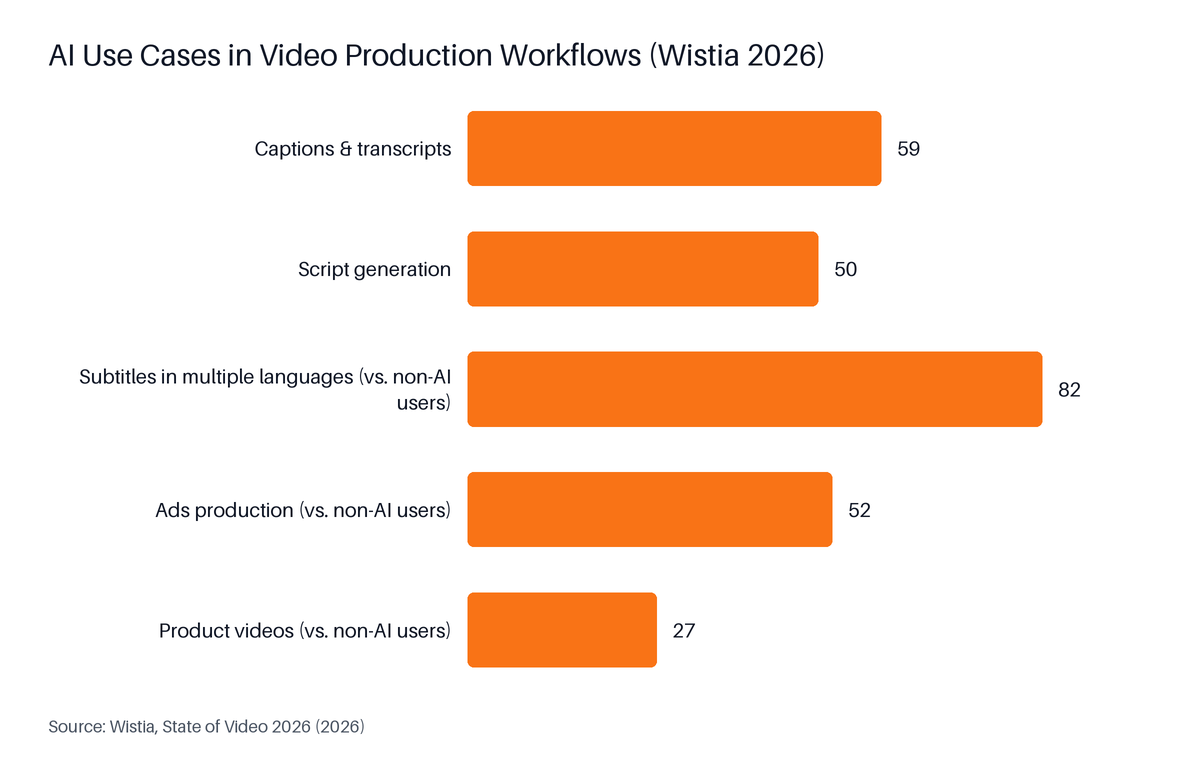
Horizontal Bar chart: AI Use Cases in Video Production Workflows (Wistia 2026). Highest: Subtitles in multiple languages (vs. non-AI users) at 82.
Among teams already using AI in video workflows, 59% use it for captions and transcripts and 50% for script generation (Wistia, State of Video 2026, 2026). Those workflow advantages compound when applied to high-volume SDR outreach.
I Need a Sales Video Maker My Reps Can Use Without Editing Skills. What Should I Look for?
A sales video maker built for non-editors should require zero post-production: no timeline, no cuts, no exports. AI Personalization is the ability to insert a prospect's name, company, or website into the video automatically, without the rep re-recording. Wistia's 2026 State of Video found in-house video teams jumped from 36% to 54% in two years (Wistia, 2026 State of Video Webinar, 2026), confirming rep-level self-service creation is now the industry standard, not a workaround.
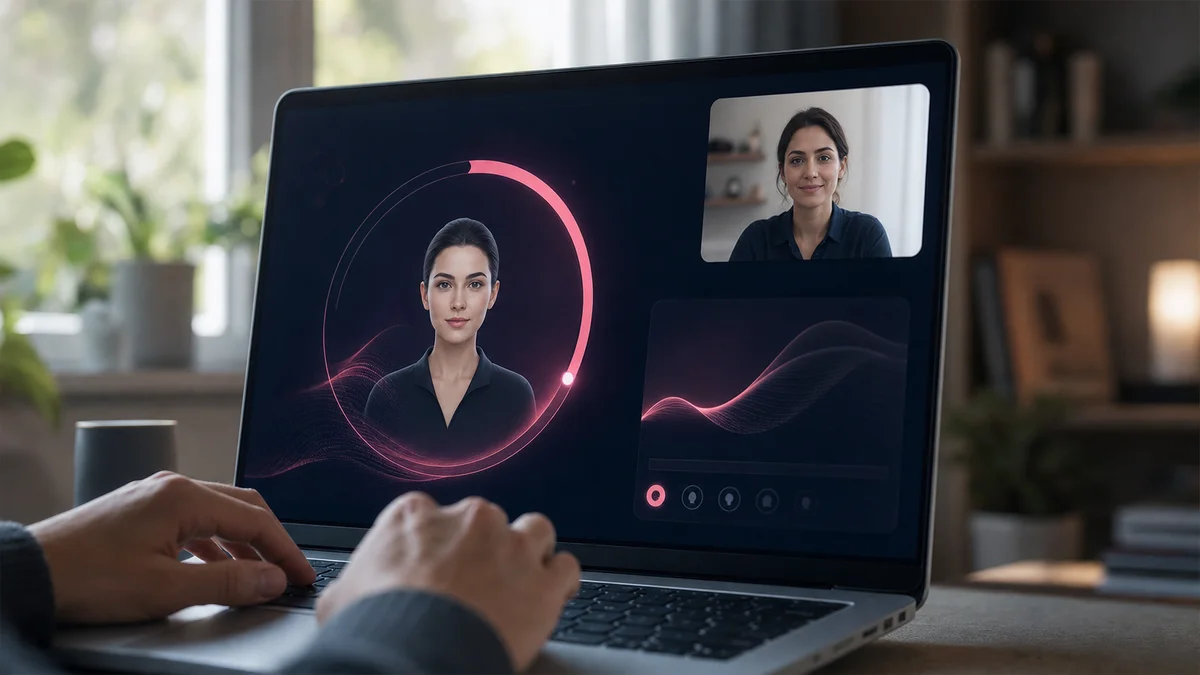
Close-up of a face cloning AI interface showing a sales rep's avatar training progress
Must-have features for a no-edit sales video maker
Look for these capabilities before committing to any platform:
One-take generation: The rep records a master video once. The platform handles every personalized output.
CRM triggers: Videos fire automatically when a prospect hits a workflow stage in HubSpot, Salesforce, Outreach, or Apollo.
Auto-captions and transcripts: Generated without the rep touching an editor.
Branded landing pages: Each video link opens on a custom-domain page with the rep's logo, a calendar embed, and a call-to-action (CTA) button.
Animated GIF previews: The email thumbnail is generated automatically. The rep creates nothing manually.
Bulk send via CSV: Upload a prospect list and the platform generates and distributes each personalized version.
Time-to-first-video benchmark
A rep with no editing skills should send their first personalized AI video within their first hour on the platform. Avatar training that requires days of footage is a hard disqualifier for busy SDR teams. Potion is designed so a rep completes avatar training in a few minutes, with roughly 30 spoken sentences, and pushes automated campaigns the same day.
Criterion
Manual recorder
AI generation platform (e.g., Potion)
Editing skills required
Yes, for trimming and uploads
None
Time to first send
Minutes per video, every day
Once for training; automated at scale afterward
CRM-triggered automation
Rarely native
Native (HubSpot, Salesforce, Outreach, Apollo)
Personalization method
Re-record per prospect
AI inserts name, company, dynamic background
Volume per rep per day
15 to 20 videos
Hundreds to thousands
Analytics for managers
Basic view counts
Watch time, replay, booking conversions, CRM sync
Is There a Sales Video Creator That Clones My Own Face and Voice Instead of Using a Stock Avatar?
Yes. A self-clone sales video creator trains a lip-sync and voice model exclusively on the rep's own face and voice, producing personalized videos that look and sound like the rep rather than a generic stock avatar. Potion requires a few minutes of webcam footage and roughly 30 spoken sentences, after which reps can generate thousands of personalized versions from one master recording. Webcam-consent verification ensures only the rep's own likeness is cloned.
Sales manager reviewing a video analytics dashboard showing watch time and booking rates
The category is moving quickly. ElevenLabs launched its Avatars feature inside ElevenCreative in June 2026, pairing voice cloning with lip-sync video. Reps can now write a script, select a cloned voice, and receive a finished talking-head clip without a recording session (Guideflow, 2026, 2026). Self-clone capabilities are becoming table stakes, not a premium differentiator.
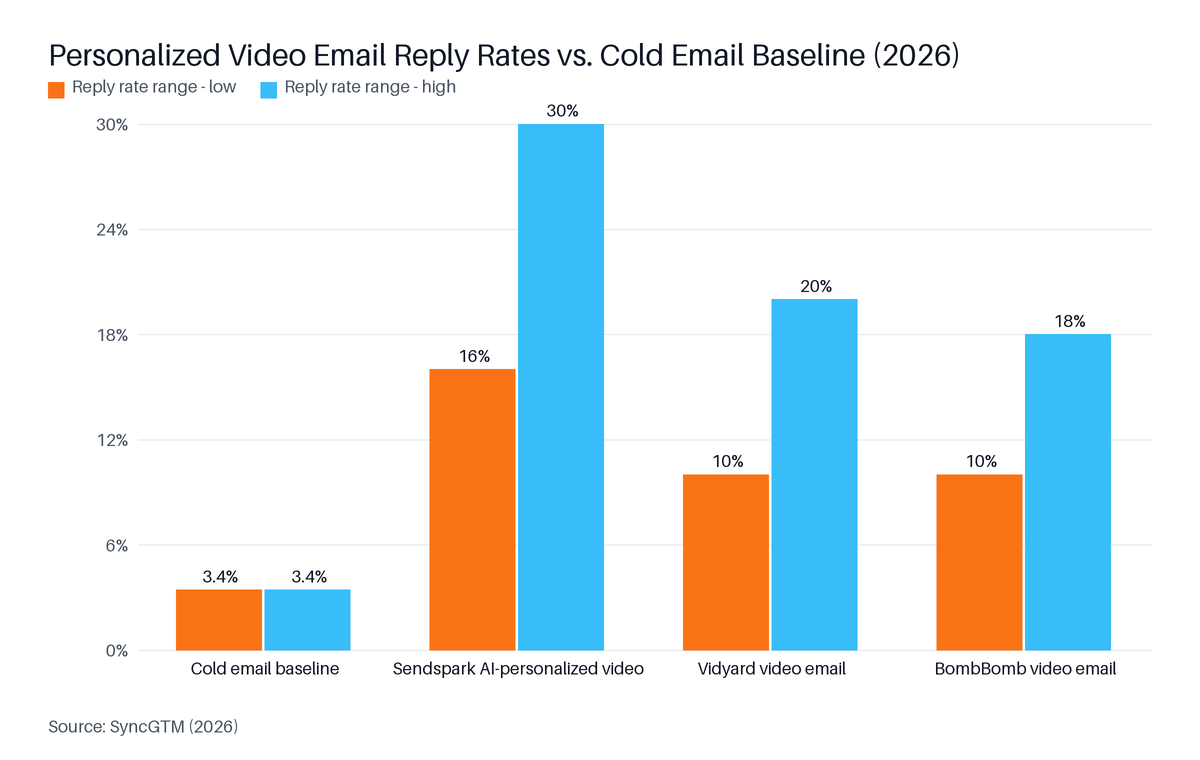
Reply rates confirm the difference matters. Sales teams using AI-personalized video report reply rates of 16 to 30% compared with the 3.43% cold-email baseline (SyncGTM, 2026, 2026), a 5 to 9x lift. Most of that lift depends on the video feeling like genuine outreach from the actual rep. Personalized video in sales outreach can deliver a 216% higher response rate than text-only emails (Terminus via Levitate Media, 2026, 2026).
Grouped Bar chart: Personalized Video Email Reply Rates vs. Cold Email Baseline (2026). Highest: Sendspark AI-personalized video at 16%.
Self-clone vs. stock avatar: what changes for your reps
Self-clone video creator is a platform that trains a unique voice and lip-sync model on an individual rep's biometric data, generating outputs that replicate that specific person's appearance and voice.
Stock avatar video creator is a platform that assigns the user a pre-built digital persona: one no prospect will recognize as the rep who sent the email.
For cold outreach where trust is built before the first meeting, the self-clone model is the stronger choice. Stock avatars suit corporate training or internal video better than SDR outbound sequences.
Potion holds a 4.5+ star rating on G2 in the Video Prospecting and AI Video Creation categories (G2, 2026) and was named #1 Product of the Day on Product Hunt. Those third-party signals matter when evaluating whether a self-clone platform is trusted by other sales teams.
Compliance and consent for voice and face cloning
Sales video creator platforms that handle voice and face cloning data operate in a regulated environment. Look for:
Webcam-only consent verification (the rep can only clone their own likeness)
SOC 2 Type I independent audit confirming security controls
Data Processing Agreement (DPA) is a legally binding contract between a data controller and a data processor, required under General Data Protection Regulation (GDPR) and California Consumer Privacy Act (CCPA) frameworks
TLS 1.2 encryption for data in transit
AWS hosting with SOC 1, SOC 2, SOC 3, and ISO 27001 compliance inherited
Potion, for example, holds SOC 2 Type I certification, is hosted on AWS, and offers Data Processing Agreements (DPAs) for GDPR and CCPA alignment. Any copy on biometric data handling should be reviewed by your legal team or Data Protection Officer (DPO) before a vendor agreement is signed.
Who This Approach Is Not For
AI video generation at scale suits high-volume outbound SDR teams; Salesforce's 2026 State of Sales confirms 87% of sales orgs now use AI in the cycle (Salesforce, State of Sales 2026, 2026), but adoption concentrates in outbound motions. Enterprise deals above USD 100,000 Annual Contract Value (ACV), heavily regulated industries, and companies with no outbound team see little ROI from automated generation and are better served by selective manual recording.
Specifically, AI video generation at scale is a poor match for:
Tier-1 Account-Based Marketing (ABM) accounts where executive buyers can detect lip-sync artifacts and AI video can erode trust in high-stakes deals.
Healthcare, defense, and government sectors where HIPAA, security clearances, and procurement rules block or extend biometric and AI-cloning vendor reviews.
Inbound-only or product-led growth (PLG) companies with no outbound SDR motion. The return on investment comes from scaling outbound, so these teams see low adoption.
Low-ticket products with Annual Recurring Revenue (ARR) below approximately USD 50 per month. The platform cost does not recover from a low average deal size.
If your team runs high-volume outbound to mid-market accounts with dedicated SDR or Business Development Representative (BDR) teams, AI generation is almost always the better call.
Frequently Asked Questions
Do my reps need video recording software, or can AI create the videos from one take?
Reps no longer need to record every video individually. AI video generation platforms require one short recording session to train a voice and face model, then generate thousands of personalized videos automatically from a CSV or CRM trigger. AI tools reduce production time by 60 to 80% compared to traditional workflows (Pictory AI, 2026, 2026). Traditional video recording software for sales teams remains useful for one-off, high-touch outreach where spontaneity matters most.
Which video messaging tools give managers analytics on who watched and who booked?
The best top video messaging tools for sales teams provide per-contact watch time, replay heatmaps (a visual record of which segments of a video a prospect rewatched, indicating moments of highest interest), drop-off points, and booking conversions on a single dashboard. The strongest platforms push watch events directly into Salesforce or HubSpot opportunity records. Sales teams using AI-personalized video report reply rates of 16 to 30% versus the 3.43% cold-email baseline (SyncGTM, 2026, 2026).
The table below maps the key analytics metrics managers should expect:
Analytics metric
What it measures
Where it appears
Per-contact watch time
How many seconds each named prospect watched
Individual contact record and manager dashboard
Replay heatmap
Which segments a prospect rewatched
Video detail view, accessible per send
Drop-off point
Where in the video most prospects stopped watching
Campaign-level reporting
Booking conversion
Whether a prospect clicked the calendar embed and booked
Landing page analytics, synced to CRM
CRM opportunity sync
Watch events pushed to Salesforce or HubSpot pipeline records
CRM opportunity or deal view
Which tools integrate video watch data directly into Salesforce or HubSpot opportunity records?
Platforms built for SDR outbound, such as Potion, push individual video watch events into Salesforce and HubSpot opportunity records natively. A manager can open a deal record and see whether the prospect watched the video, how long they watched, and whether they booked a meeting, without switching to a separate analytics tool. Native CRM sync is a key filter when evaluating any video messaging platform.
How long does it take a rep with no editing skills to send their first personalized video?
A rep with no editing skills should send their first AI-personalized video within their first hour on the platform. Potion is designed so avatar training takes a few minutes of webcam footage and roughly 30 spoken sentences. After training, the rep uploads a prospect CSV and the platform generates and distributes personalized videos automatically. No editing, trimming, or exporting is required at any stage.
The Verdict: Which Type of Tool Fits Your Team?
Sales teams should choose AI generation when outbound volume exceeds 20 prospects per rep per day, the point where manual recording consumes more time than it generates in pipeline. Teams running one-to-one enterprise deals below that threshold are better served by a traditional screen recorder used selectively. For most mid-market SDR teams of five or more reps, the manual model has already hit its ceiling.
Supporting evidence: 82% of video marketers confirm that video delivers a positive ROI (Wyzowl, State of Video Marketing 2026, 2026), and sales teams using AI-personalized video report reply rates of 16 to 30% versus the 3.43% cold-email baseline (SyncGTM, 2026, 2026).
Manual screen recorder: Choose this for senior Account Executives (AEs) running one-to-one outreach on a small named account list, where spontaneity is the differentiator.
AI generation with face and voice cloning: Choose this when your SDR team needs to reach hundreds of qualified prospects per week, your current recording workflow consumes more than a few hours per rep per day, and you need manager-level analytics tied into your CRM.
Hybrid approach: Some teams use AI generation for top-of-funnel sequences and reserve manual recording for post-demo follow-up or contract-stage nudges.
Pricing model comparison
Not all platforms price the same way. Before signing, confirm whether AI generation credits are included in the base plan or billed separately.
Pricing model
How it works
Watch for
Per-seat flat rate
Fixed monthly or annual cost per rep regardless of volume
Check whether AI credits are additive or inclusive
Credit-based (per video)
Pay per video generated; base seat may be cheaper
Costs scale fast at high volume; model the monthly credit burn
Volume tier
Seat cost drops as team size grows
Confirm the tier threshold before committing annual ARR
Potion's public plans start at USD 99 per month (Starter) and USD 299 per month (Professional), with custom plans for teams needing whitelabeling or enterprise onboarding. A 7-day free trial is available with no sales contact required for self-serve seats.
SAP closes USD 500,000-plus in pipeline using Potion's AI-generated videos (Potion customer data). GrowPronto booked 45 meetings and closed 7 accounts using the same platform (Potion customer data). The ROI benchmark is established. The question is whether your team acts this quarter or waits.
When you are ready to evaluate the full range of options, the guide to choosing a personalised video prospecting platform covers every decision point from integrations to compliance (link to be added on publish).
Ready to see how AI video generation fits your current SDR workflow? Start your free 7-day trial at sendpotion.com and have your first AI-personalized video sending the same day.
Written by
Carlos Agüero
Carlos Agüero builds tools that help B2B sales teams sell smarter. As part of TargetGrid.ai, Skale.email, and Potion, he's focused on multi-channel outreach automation, inbox deliverability, and AI-powered video. Berkeley Haas COBE. Based in Santiago, Chile. Passionate about helping sales teams close more, faster, with less manual work.

 Carlos AgüeroOct 17, 2026