By Carlos Agüero. He builds B2B outreach automation, inbox deliverability and AI video tools at TargetGrid.ai, Skale.email and Potion, and studied at Berkeley Haas (COBE). Published October 22, 2026. Potion is the product behind this blog.
The easiest prospecting tools to onboard a new Sales Development Representative (SDR) team plug into your Customer Relationship Management (CRM) system, need one login, and let a rep send a first sequence within days. You are hiring five reps. Every extra tool is one more thing each of them must learn before they book a meeting. This guide gives you a three-layer starter stack, selection criteria, a place for video, a deliverability limit and a day-by-day plan. For the full playbook, see the video prospecting playbook for SDR teams.
Key Takeaways
A new SDR team can start with three tools: a data source, a sequencer synced to the CRM, and one video tool inside that sequencer.
Text-only cold email averages a 3.43% reply rate (Instantly, 2026), the baseline any video step has to beat.
Google's bulk sender guidance says to keep the reported spam rate below 0.10% (Red Sift, 2026), so new teams should scale send volume in steps.
Independent video-versus-text benchmarks are scarce, so treat vendor reply-lift claims as claims, not guarantees.
What are the easiest prospecting tools to onboard a new SDR team?
The easiest prospecting tools for a new SDR team are a contact data source, a sequencer that syncs with the CRM, and one video tool that lives inside that sequencer. Three tools is enough for week one. The Bridge Group's 2025 report puts average SDR ramp time at 3.0 months, so every week of tool friction is costly (The Bridge Group, 2025).
A sales manager and a new SDR reviewing a short onboarding checklist together at a window-lit table
A prospecting stack is the set of tools an SDR team uses to find contacts, send sequences and track replies. Ramp time is the number of months a new SDR needs to reach full productivity. The same Bridge Group study found only 60% of SDRs at quota, the lowest in the study's history (The Bridge Group, 2025). Slow onboarding is not a small problem.
A three-layer starter stack
The layers below are categories, not a ranking of brands. Pick any tool that passes the adoption test.
Layer
Job
Week-one adoption test
Start in week one?
Contact data
Find and verify prospects
A rep can build a 50-contact list in one sitting
Yes
Sequencer
Send timed multi-step emails, log to CRM
A rep can launch a template sequence without help
Yes
Video tool
Add a personalized video to a step
The video sends from inside the sequencer
Yes, one tool
Enrichment add-ons
Deeper research and signals
Only needed once lists run dry
No, defer
Conversation intelligence
Call review and coaching
Only useful after calls are happening
No, defer
How to judge "easy to onboard" for each layer
Tool names change fast, so judge each layer against a fixed rubric instead of a brand list.
Layer
Check before you buy
Red flag
Contact data
Verified emails, CRM export, a filter a new rep can learn in an hour
Sends from inside the sequencer, bulk input by CSV or CRM trigger, hosted video page
One recording per prospect with no bulk option
All layers
Public security documents so compliance can sign off fast
No documentation until after purchase
What tools help GTM teams use video in outreach?
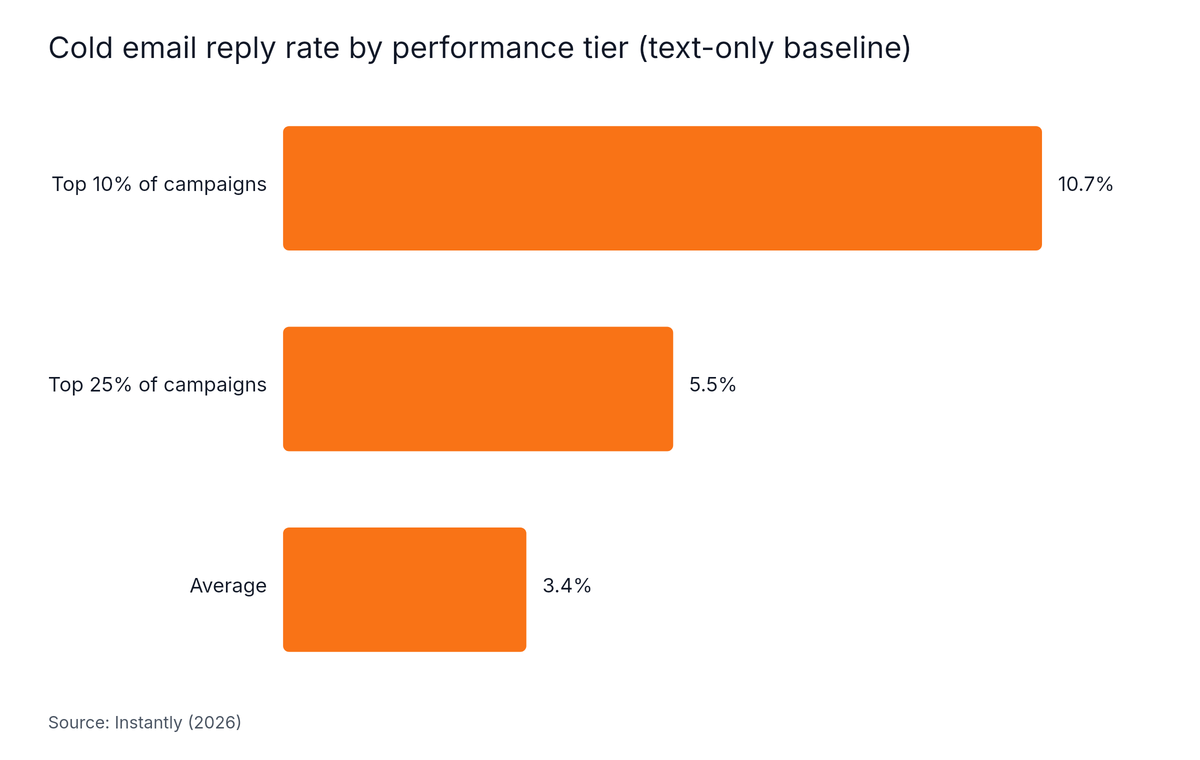
Video outreach tools for GTM teams come in three types: recorders that capture one video per prospect, generative platforms that turn one recording into many personalized videos, and hosting pages that deliver them with a call to action. Text-only cold email averages a 3.43% reply rate (Instantly, 2026), the baseline any video step has to beat.
Horizontal Bar chart: Cold email reply rate by performance tier (text-only baseline). Highest: Top 10% of campaigns at 10.7%.
Instantly's 2026 data puts the top 10% of text-only campaigns at a 10.7% reply rate and the top 25% at 5.5% (Instantly, 2026). Good targeting and copy already lift text a long way. Judge video against that spread, not against the average alone.
Video prospecting is the use of short, personalized videos as steps in outbound sales sequences. Here is how the three tool types compare for a new team:
Tool type
Best for
Scales to hundreds per week?
Week-one effort
Manual recorder
A few high-value accounts
No, one recording per prospect
Low
Generative video platform
Bulk outbound from one recording
Yes, from a CSV or CRM trigger
Medium: record a master video once
Video landing page
Delivery, branding, calendar link
Yes
Low if bundled with the generator
Manual recording is simple to learn but caps output. A rep who records every video by hand reaches only so many prospects a day. Generative platforms remove that cap by cloning a rep's own face, voice and gestures from one recording. For a shortlist by use case, see best video prospecting tools for SDR teams and video messaging software for sales teams.
Be careful with reply-rate claims. Most video lift numbers come from vendors or are repeated second-hand. No independent, methodology-backed benchmark of video against text in cold outreach turned up in the research for this guide.
What stack do we need to put video in every sequence step?
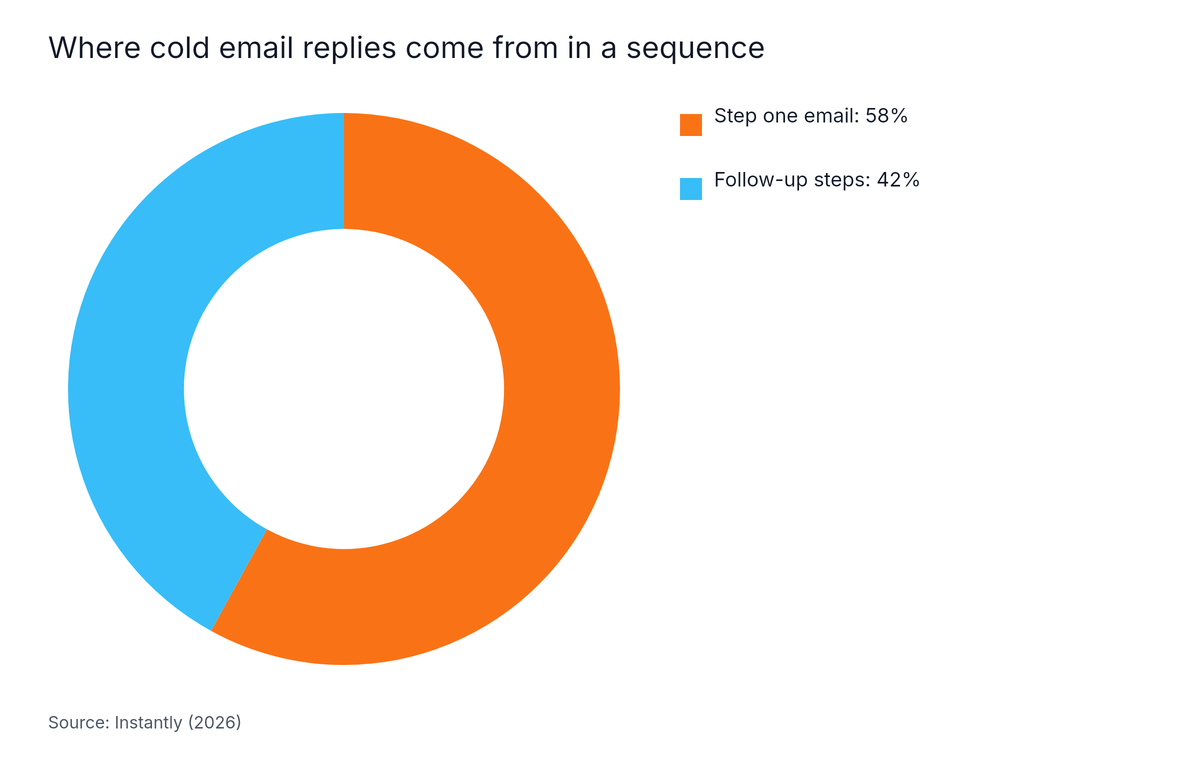
A GTM team that wants video in every sequence step needs four pieces: a contact data source, a sequencer, a video generator that works from a CSV or CRM trigger, and a hosted video page with a calendar link. Instantly's 2026 data shows 58% of cold email replies arrive on step one, and 42% come from follow-ups (Instantly, 2026).
Donut chart: Where cold email replies come from in a sequence. Highest: Step one email at 58%.
That split sets your priority. Step one carries most replies, so it gets the best video. The follow-ups bring in 42% of replies (Instantly, 2026), which is enough that a short second video is worth the effort. A sensible first rollout puts video in step one and one follow-up, then extends it once spam rates stay low.
Keep the stack small
Salesforce's State of Sales 2026 survey covered more than 4,000 sales professionals. It found that 87% of sales organizations already use some form of AI. It also found that 54% of sellers have used AI agents (Salesforce, 2026). Your reps will expect AI help. But more tools do not always mean more output. Gartner warned in November 2025 of a "value ceiling" on tool layering (Gartner, 2025).
A Gartner survey from May 2026 adds a second warning. AI saves sellers an average of 4.8 hours a week, yet 72% of sales organizations report low reinvestment of that time (Gartner via BusinessWire, 2026). Saved time only helps if managers tell reps where to spend it. To see how bulk video works without recording each clip, read how to send personalized videos at scale.
How do you keep high-volume prospecting personal without hurting deliverability?
High-volume prospecting stays personal when each message uses prospect-specific content and stays under spam limits. Google's bulk sender guidance says to keep the reported spam rate below 0.10% and never let it reach 0.30% (Red Sift, 2026). Since November 2025, Gmail rejects non-compliant bulk mail permanently with 550 errors, so volume has to scale in steps.
An SDR recording a short facecam video with a small ring light and a notebook beside the laptop
Spam rate is the share of delivered emails that recipients mark as spam, as reported in Google Postmaster Tools. The Red Sift guide is a vendor summary, not Google's own page. Check Google's sender guidelines before you set policy.
Guardrails for a new team
Start each rep at a low daily send count and raise it weekly.
Check the spam rate every week and pause any campaign that drifts toward Google's limit.
Use real prospect-specific content, such as a name greeting or a screen recording over the prospect's own website, not a swapped first name alone.
Link to a branded video page instead of attaching large files.
Keep each rep's video limited to their own face and voice, and put the consent rule in writing.
A new SDR team can run a working first sequence by Friday by following a fixed order. Day one covers logins and CRM sync, day two data and list rules, day three the sequence build, day four a video template, and day five a small send. Each day ends with a done-when check a manager can verify.
A team lead writing a five-day plan on a whiteboard while two new SDRs watch
Day
Task
Stack layer
Done when
Monday
Logins, CRM sync, permission check
All
Every rep can sign in and see the CRM
Tuesday
Build a first list, set data rules
Contact data
Each rep has 50 verified contacts
Wednesday
Build a template sequence
Sequencer
Sequence approved by the manager
Thursday
Record one master video, add it to step one
Video tool
Test video sends to the manager
Friday
Small live send, check spam and replies
All
Spam rate and bounces reviewed
The first week is a small slice of a longer ramp, but it sets the habits. This is a suggested plan, not a measured result. Adjust the pace to your team's experience. Scripts and formats are in video prospecting examples that got replies.
Who is this week-one stack not for?
The three-tool week-one SDR stack is not right for every team. It fits outbound email teams that already have a CRM. It fits poorly for enterprise buyers with long security reviews, teams without a CRM, or anyone expecting guaranteed reply lifts. Proof of return matters: 31% of chief sales officers cite proving AI tool ROI as a top challenge (Gartner via BusinessWire, 2026).
A sales leader reading a printed security and compliance summary with a pen in hand
Know these limits before you buy:
Security review takes time. Enterprise-size deals often add weeks for security, IT, privacy and legal review, especially for voice and face cloning. Potion holds SOC 2 Type I and is hosted on AWS, with Data Processing Agreements for GDPR and CCPA alignment, so compliance can start from public documents.
Personalization has limits. Templated video that feels generic can still be ignored. The content has to match the prospect.
Reply gains are not guaranteed. Vendor claims vary widely, so run your own test against your text baseline and keep a record of results for the ROI question.
Very small or very large teams differ. A solo rep may want a single all-in-one tool. A large team may need admin and governance layers this stack leaves out.
Frequently Asked Questions
Our GTM team wants video in every sequence step. What stack do we need?
A go-to-market team that wants video in every sequence step needs a contact data source, a sequencer that syncs with the CRM, a video generator that runs from a CSV upload or CRM trigger, and a hosted video page with a calendar link. Start with video in step one and one follow-up, then extend as deliverability holds.
Which platform lets an SDR team keep high-volume prospecting without losing the personal touch?
The best platform for high-volume SDR prospecting is one that generates a personalized video per prospect from a single recording and sends it through your existing sequencer. Look for prospect-specific backgrounds, a name greeting, CSV or CRM triggers, and a branded landing page. Pair it with spam-rate limits so volume does not hurt deliverability.
How many tools should a new SDR team start with in week one?
A new SDR team should start with three tools in week one: a data source, a sequencer synced to the CRM, and one video tool that plugs into that sequencer. Gartner warned in November 2025 of a value ceiling on tool layering (Gartner, 2025), so defer add-ons until reps are sending.
Does the Gmail and Yahoo bulk sender policy affect SDR sequences that include video?
Yes, the Gmail and Yahoo bulk sender rules apply to any SDR sequence, including steps that carry a video link. Google's guidance, as summarized by Red Sift (Red Sift, 2026), says to keep the reported spam rate below 0.10% and never let it reach 0.30%. Since November 2025, non-compliant bulk mail gets permanent 550 rejections.
Your week-one shortlist
A new SDR team can finish its week-one tool setup with three tools: a contact data source, a sequencer synced to the CRM, and one video tool. The Bridge Group's 2025 report puts SDR ramp time at 3.0 months, so a small stack that reps learn quickly shortens the slowest part of that window (The Bridge Group, 2025).
Five reps, five days, three tools. That is a plan a new team can finish.
Start with a data source, a CRM-synced sequencer and one video tool, and defer everything else.
Judge every tool on CRM sync, sequencer fit, day-one usability, admin controls and public security documents.
Put your best video in step one, where 58% of replies arrive (Instantly, 2026), and add a follow-up video next.
Keep the spam rate below 0.10% (Red Sift, 2026) and raise send volume weekly.
Test video against your own text baseline before you promise pipeline.
If your reps spend more time recording than prospecting, start with the video layer. Start Free Trial, record one master video, and generate AI videos in your own face, voice, and gestures at scale. Then read the video prospecting examples for scripts your team can copy.
Written by
Carlos Agüero
Carlos Agüero builds tools that help B2B sales teams sell smarter. As part of TargetGrid.ai, Skale.email, and Potion, he's focused on multi-channel outreach automation, inbox deliverability, and AI-powered video. Berkeley Haas COBE. Based in Santiago, Chile. Passionate about helping sales teams close more, faster, with less manual work.

 Carlos AgüeroOct 29, 2026