Last updated: Nov 10, 2026
UK GDPR and Legitimate Interest for B2B Cold Email
By Carlos Agüero | Last reviewed: October 22, 2026

Can you use legitimate interest for B2B cold email under UK GDPR? Learn the PECR consent test, LIA steps, 2026 fines and EU rules for compliance leads.
 Carlos AgüeroNov 10, 2026

Last updated: Nov 10, 2026
By Carlos Agüero | Last reviewed: October 22, 2026
Is cold email legal? Compare CAN-SPAM, CASL, UK PECR and Australia's Spam Act: legal basis, 2026 fines, enforcement cases, footer text and a checklist.

What a video landing page for sales outreach should include: five elements, templates by scenario, benchmarks and a QA checklist for SDR teams.

Why AI automation agency cold outreach fails in 2026: benchmark data, deliverability limits, AI SDR results and a six-step workflow that works.
Request a quote and our experts will contact you within 24 hours with tailored solutions and pricing.
You can also send us a quick email at support@sendpotion.com.
Legitimate interest for B2B cold email is a UK GDPR lawful basis that lets you email business contacts without prior consent, but only where PECR does not require consent and a documented balancing test shows the outreach is fair. PECR, the Privacy and Electronic Communications Regulations, is where many plans fail. This gdpr cold email legitimate interest guidance gives UK compliance leads the two-layer test, a working assessment, the 2026 penalty picture and the EU position. If your team also tests video in first-touch cold email, the same rules apply to it.
Key Takeaways
- Legitimate interests under UK GDPR can cover B2B cold email only where PECR does not require consent for that recipient.
- PECR fines now reach £17.5 million or 4% of global annual turnover, up from £500,000, since 5 February 2026 (Clifford Chance, 2026).
- A legitimate interests assessment (LIA) should record purpose, necessity and balancing before the first send.
- EU cold email is decided by each country's national ePrivacy law, not by GDPR alone.
UK GDPR legitimate interests can support B2B cold email to UK prospects, but only where the Privacy and Electronic Communications Regulations (PECR) do not require consent. The Information Commissioner's Office (ICO) states that "Legitimate interests can apply for direct marketing but only where the Privacy and Electronic Communication Regulations (PECR) don’t require consent." (ICO, 2026)

Legitimate interests is one of the six lawful bases in UK GDPR. It lets an organisation process personal data for a genuine business purpose, if that purpose passes a balancing test against the individual's rights. The ICO has described it as "the most flexible lawful basis" (DMA, 2026), as quoted by the Data & Marketing Association.
The ICO updated its guidance on 23 March 2026 after the Data (Use and Access) Act 2025 (DUAA), the UK law that amended parts of UK data protection law. Direct marketing is now named as a possible legitimate interest. The new "recognised legitimate interests" basis does not cover commercial marketing, so do not use it for outreach.
Flexible does not mean automatic. You still have to pass two separate tests, covered next.
Cold B2B email in the UK passes through two layers. First, PECR decides whether the recipient must have consented. Second, UK GDPR requires a lawful basis for processing the contact's personal data, and legitimate interests is usually the one. Failing the PECR layer ends the analysis, however strong your legitimate interests assessment looks.

PECR is the UK rulebook for electronic marketing by email, call and text. The difference that matters is the type of subscriber. A corporate subscriber is a limited company, a limited liability partnership (LLP) or a Scottish partnership. Individual subscribers include sole traders and ordinary partnerships.
| Recipient type | Examples | PECR consent for cold email? | Practical rule |
|---|---|---|---|
| Corporate subscriber | Limited company, LLP, Scottish partnership | No prior consent required | Identify yourself, give a contact address, honour opt-outs, and document legitimate interests |
| Individual subscriber | Sole trader, ordinary partnership | Yes, consent required | Do not send cold email without consent |
| Named work address at a corporate | firstname.surname@company.com | Follows the company's status | Still personal data, so complete an LIA and honour objections |
| Existing customer | Previous buyer of a similar product | Soft opt-in may apply | Offer a clear opt-out at collection and in every message |
The soft opt-in is a narrow PECR exemption for existing customers and people who negotiated a sale with you. It does not apply to a first message to a stranger. The ICO fined Allay Claims Ltd £120,000 for 4,046,947 marketing texts sent without valid consent or a valid soft opt-in (ICO, 2026).
A legitimate interests assessment (LIA) is a written, three-part test of purpose, necessity and balancing that shows your outreach is fair to the people you email. For B2B cold email, you record why you contact a role, whether email is needed, and how the recipient's expectations and rights weigh against your commercial aim.

The ICO's legitimate interests guidance (2026) frames the assessment around these three tests. Complete all three before the first send.
Two follow-up actions sit alongside the test. Record the decision with a date, an owner and a review schedule. Then check your transparency duties, including any privacy notice owed when you obtain data from a third party.
| LIA part | Question to answer | Example wording |
|---|---|---|
| Purpose | What are we trying to achieve? | "Introduce our reporting software to heads of finance at UK limited companies." |
| Necessity | Is email needed and proportionate? | "Email is the least intrusive channel, and we use only name, role and work address." |
| Balancing | Would the person reasonably expect this? | "Recipients hold roles relevant to the offer, and each message has a one-click opt-out." |
| Safeguards | What limits the impact? | "Suppression list, source records and objection handling across all systems." |
The necessity test is where bought data fails. The ICO fined ZMLUK Limited £105,000 for over 67 million marketing emails sent without valid consent, using data sourced from third parties (ICO, 2026). If a contact comes from a broker, check the consent chain and keep the source and date for every record.
Cold B2B email can be GDPR-compliant in the EU, but GDPR does not settle the question alone. National ePrivacy laws, which implement the EU ePrivacy Directive, set the consent rules for email in each member state, and they vary. Treat each country separately, check its law or data protection authority guidance, and keep your documented lawful basis ready.

Blog posts often label whole countries "permissive" or "strict" and disagree with each other. Do not copy those labels. Read the national transposition of the ePrivacy Directive and any guidance from that country's data protection authority, then record your conclusion in the LIA.
For senders holding EU contacts, the European Commission renewed the UK's two adequacy decisions for six years, to December 27, 2031, with a mid-point review after four years (Hunton Andrews Kurth, 2025). EU and UK personal data flows can continue. That covers transfers, not email consent.
The EDPB and EDPS adopted Joint Opinion 2/2026 on the Digital Omnibus proposal, which would amend GDPR and the ePrivacy Directive (EDPB, 2026). It is still before Parliament and Council. As of this writing, no confirmed change to B2B email rules has come out of it.
PECR breaches, including unlawful email marketing, can now cost up to £17.5 million or 4% of global annual turnover, up from £500,000, since the Data (Use and Access) Act provisions took effect on 5 February 2026 (Clifford Chance, 2026). Enforcement against email is still infrequent and complaint-driven.

The recent picture is uneven. In the first half of 2025, the ICO issued six fines in total, none for email marketing (URM Consulting, 2025). Then in January 2026 the ICO fined ZMLUK Limited £105,000 for over 67 million marketing emails. That case concerned B2C-style consent, not corporate subscribers.
Andy Curry, the ICO's Head of Investigations, said: "The law here is clear: businesses must only send marketing messages to people who have freely and knowingly consented to receiving them." (ICO, 2026)
Recent penalties have mostly hit calls and texts rather than email. According to TrustKeith's 2026 compilation of ICO monetary penalty notices, Jacksons Marketing Ltd was fined £130,000 and Energy Prices Direct Ltd £160,000 in March 2026. Thermotech Wall and Loft Surveys Ltd was fined £240,000 and KRA Consultancy Ltd £300,000 in May 2026.
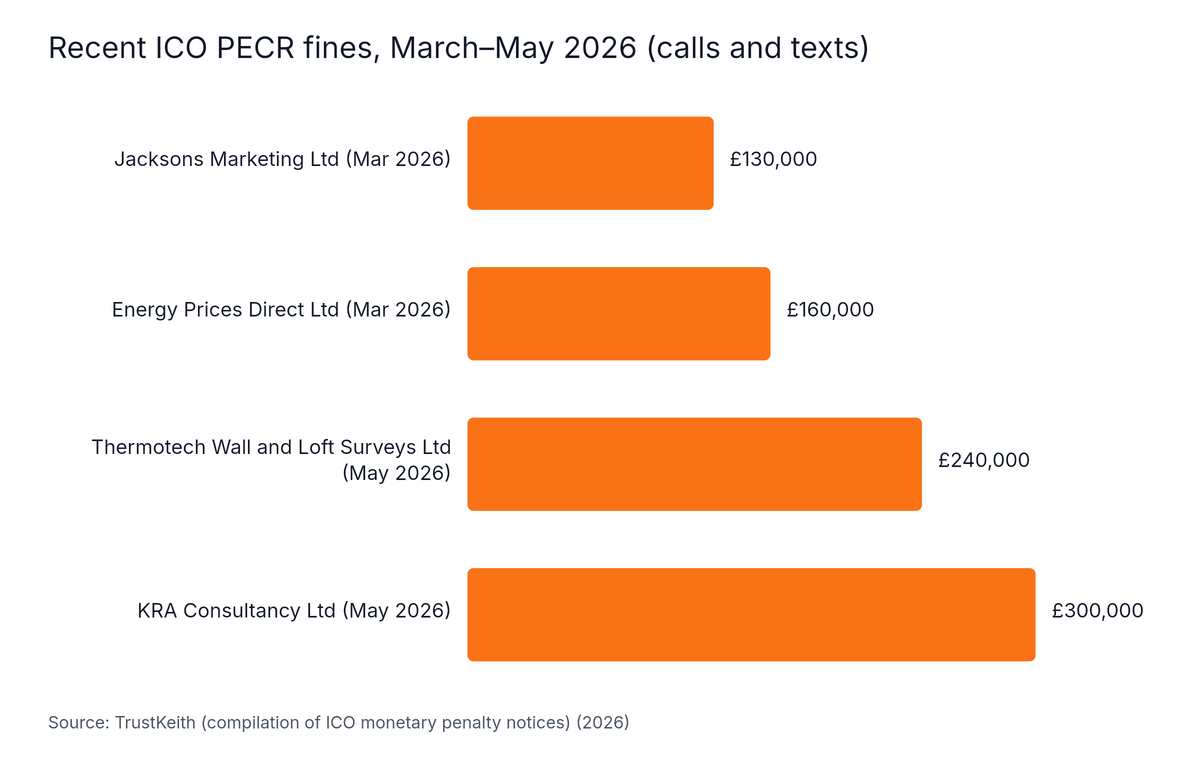
Source: TrustKeith (compilation of ICO monetary penalty notices), 2026
Three habits reduce your exposure:
UK GDPR legitimate interest guidance for B2B cold email is a general explainer for compliance and sales leads, not legal advice, and it does not fit every sender. It covers B2B email to UK prospects and gives an EU overview, but calls, texts, B2C marketing and country advice need qualified counsel. According to GRC Solutions, the ICO issued 49 PECR penalty notices worth £4.63 million from March 2022 to April 2025 (2026).
That tally combines calls, texts and emails, so it shows the scale of PECR enforcement rather than email risk alone. Some further limits:
Yes, cold email can be legal under GDPR, but the rules depend on who you email and where. GDPR requires a lawful basis, and legitimate interests can be one for B2B outreach. Separate ePrivacy rules, such as PECR in the UK, may still demand consent, particularly for individual subscribers like sole traders.
Cold B2B email can be GDPR-compliant in the EU, but GDPR alone does not decide it. Each member state's national ePrivacy law sets the consent rules for email, and they differ by country. Check the national law or data protection authority guidance for each country before sending, and document your lawful basis.
No, the soft opt-in does not cover true cold outreach. It only applies to existing customers or people who have negotiated a sale with you, and it needs a clear opt-out. The ICO fined Allay Claims Ltd £120,000 in January 2026 for misusing the exemption on marketing texts.
A work email address is personal data under UK GDPR when it identifies a living person, such as firstname.surname@company.com. Generic addresses like info@company.com are less likely to identify anyone. Because named addresses are personal data, you still need a lawful basis, transparency and a way to honour objections.
UK GDPR legitimate interest can support B2B cold email, but only after PECR clears the recipient. Keep these points in front of your team:
Our data: SendPotion's customer case study shows GrowPronto booked 45 meetings and closed 7 accounts with Potion. Outreach that performs still has to clear the PECR test first.
Once your compliance base is set, you can focus on the message itself. See how video email works for B2B sales, and read about sending personalized videos at scale. Start Free Trial.
Written by
Carlos Agüero
Carlos Agüero builds tools that help B2B sales teams sell smarter. As part of TargetGrid.ai, Skale.email, and Potion, he's focused on multi-channel outreach automation, inbox deliverability, and AI-powered video. Berkeley Haas COBE. Based in Santiago, Chile. Passionate about helping sales teams close more, faster, with less manual work.