How to Improve Cold Email Response Rates in 2025 and Beyond
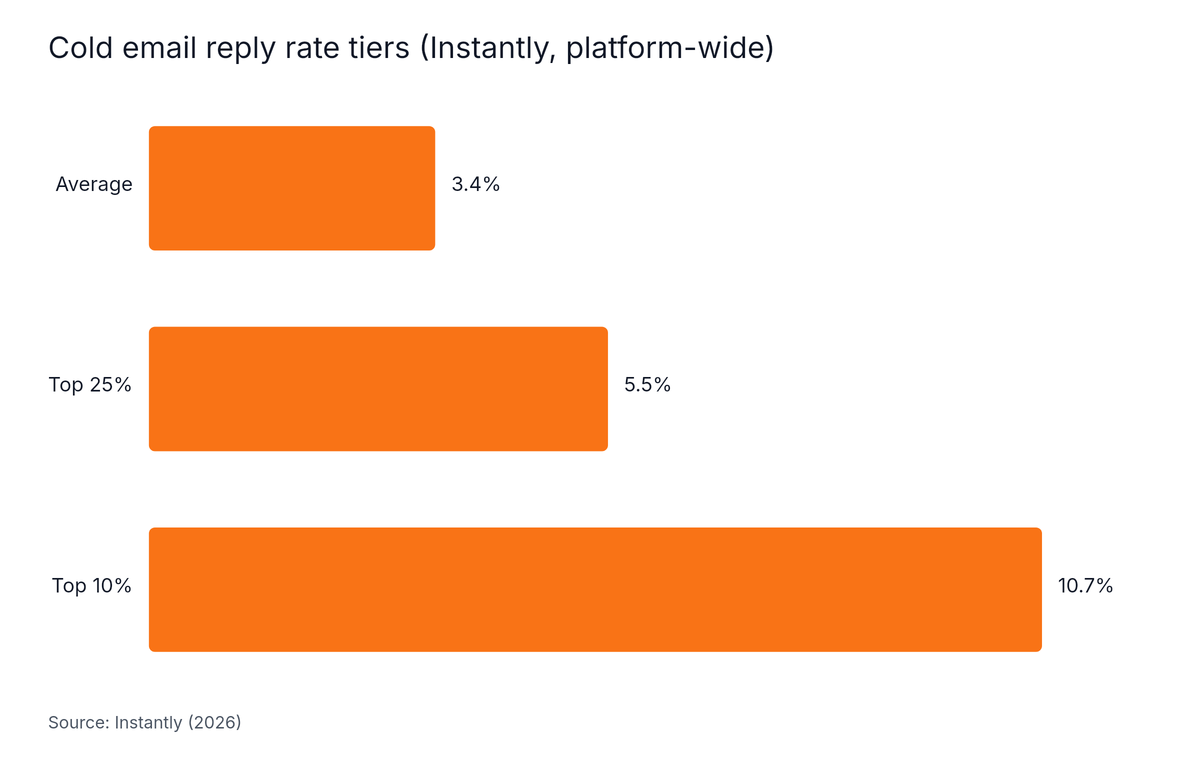
Improving cold email response rates in 2025 and after means fixing three things: whether mail reaches the inbox, whether each message is relevant to its segment, and whether a person reviews AI drafts before sending. If your reply rate slid from 3% to under 1%, the platform-wide average of 3.43% (Instantly, 2026) shows you are below the norm, and the causes can be fixed.
This guide separates causes that look alike. You will see which benchmark to compare against, how to stand out when rivals email the same prospects, and how to run a tiered weekly workflow for 500 prospects. It also covers where AI helps and where it hurts. For a related angle, see what video outreach is.
Key Takeaways
Cold email reply rates fall mainly when messages are generic or mail fails inbox checks, so rule out deliverability before rewriting copy.
In Hunter's 2026 data, cold emails with two custom attributes in the body outperformed emails with no personalization (Hunter, 2026).
A 500-prospect week works better split into small segments: Hunter found 21 to 50 recipients reply at 6.2% against 2.4% for 500 or more (Hunter, 2026).
AI-written cold emails underperform mostly when nobody edits them, and hybrid AI plus human review did best in Saleshandy's vendor test (Saleshandy, 2026).
Personalization depth, meaning trigger, problem, offer and follow-up, matters more than a clever first line.
Written by Carlos Agüero, who builds outreach automation, inbox deliverability and AI video tools for B2B sales teams.
Why did cold email reply rates drop?
Cold email reply rates drop when outreach is generic and when mail never reaches the inbox. Instantly's 2026 benchmark puts the platform-wide average reply rate at 3.43% (Instantly, 2026), and 71% of surveyed decision-makers named lack of relevancy as the main reason they don't respond (Hunter, 2025).
Top-down view of an overflowing paper inbox tray beside one clean envelope on a pale desk
Reply rate is the share of recipients or sends that receive an answer, and the denominator changes the number. That is why two honest benchmarks can disagree by several points. Before you judge your own 1%, check what each figure divides by.
Which benchmark should you compare yourself to?
Compare against a figure that uses the same denominator and a similar audience. The table lists the sourced numbers available now.
Mailbox providers now reject non-compliant mail, so a reply drop can start before anyone reads your message. Microsoft began enforcing bulk-sender requirements for Outlook, Hotmail and Live.com on May 5, 2025, and as of 2026 Google, Yahoo and Microsoft all enforce strictly (Redsift, 2026).
Run this check first:
Confirm your sending domain passes authentication for Gmail and Microsoft.
Clean the list so bounces and complaints stay low.
Send a test to your own Gmail and Outlook accounts and see where it lands.
Only then compare copy variants.
Track positive replies and meetings booked rather than opens, so you can tell which fix worked.
Every competitor emails the same prospects. How do I personalise cold outreach so ours stands out?
To stand out when every competitor emails the same prospects, personalize the reason you are writing, not only the greeting: a specific trigger, a problem tied to the prospect's role and an offer matched to their segment. Hunter's data shows emails with two custom attributes in the body reply at 5.6%, against 3.6% with none (Hunter, 2026).
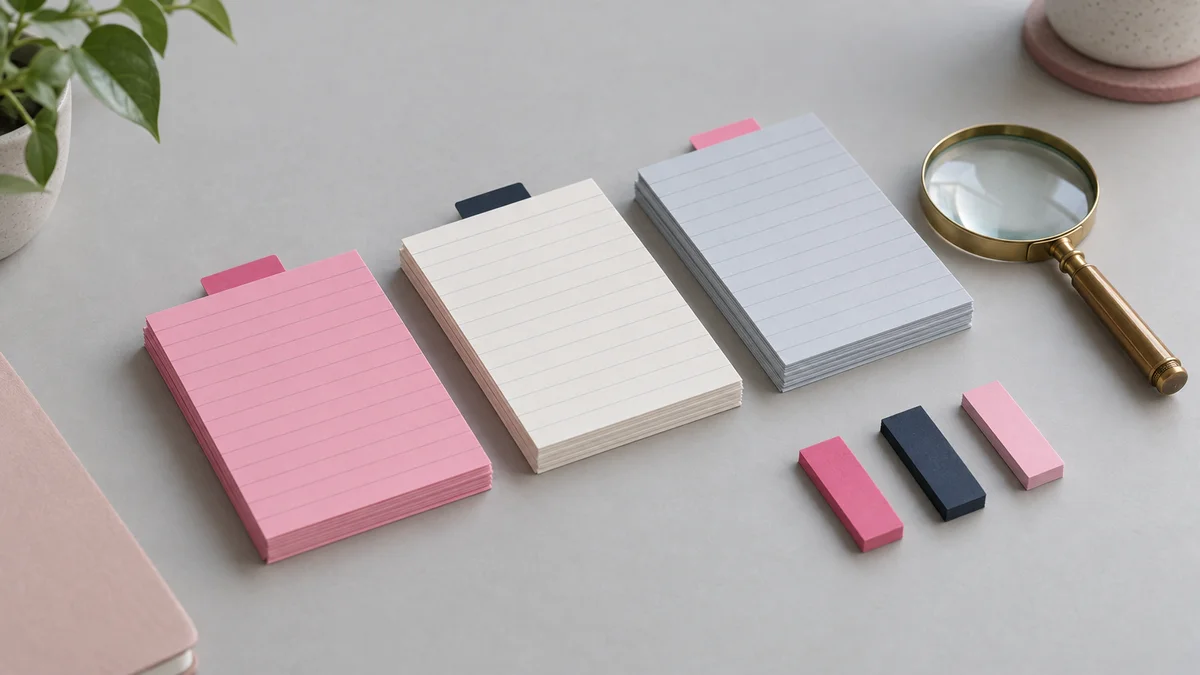
Flat lay of index cards with a magnifying glass and colored sticky tabs sorted by segment
Buyers feel the sameness. In Hunter's 2025 survey of 217 decision-makers, only 24% said they receive a valuable cold email at least once a week, and 20% said they never receive a relevant one (Hunter, 2025). The report's authors conclude: "Relevance and trustworthiness are the factors determining email outreach success in 2025." (Hunter, 2025)
A four-part test for a message that stands out
Use these questions on every template before it ships:
Trigger: what happened at this company that makes today a reasonable day to write?
Problem: which problem does someone in this role plausibly have because of that trigger?
Offer: is the ask matched to the segment, not one generic demo request?
Proof: can the prospect verify your claim in one click?
Signal-based outreach is cold outreach triggered by an observable event at the prospect, such as a hire or a product launch. It is the easiest way to answer the first question honestly.
Hunter's authors also say what segmentation takes: "It means that you need to segment your audience and put in the effort to have a personalized offer for each subsegment." (Hunter, 2026)
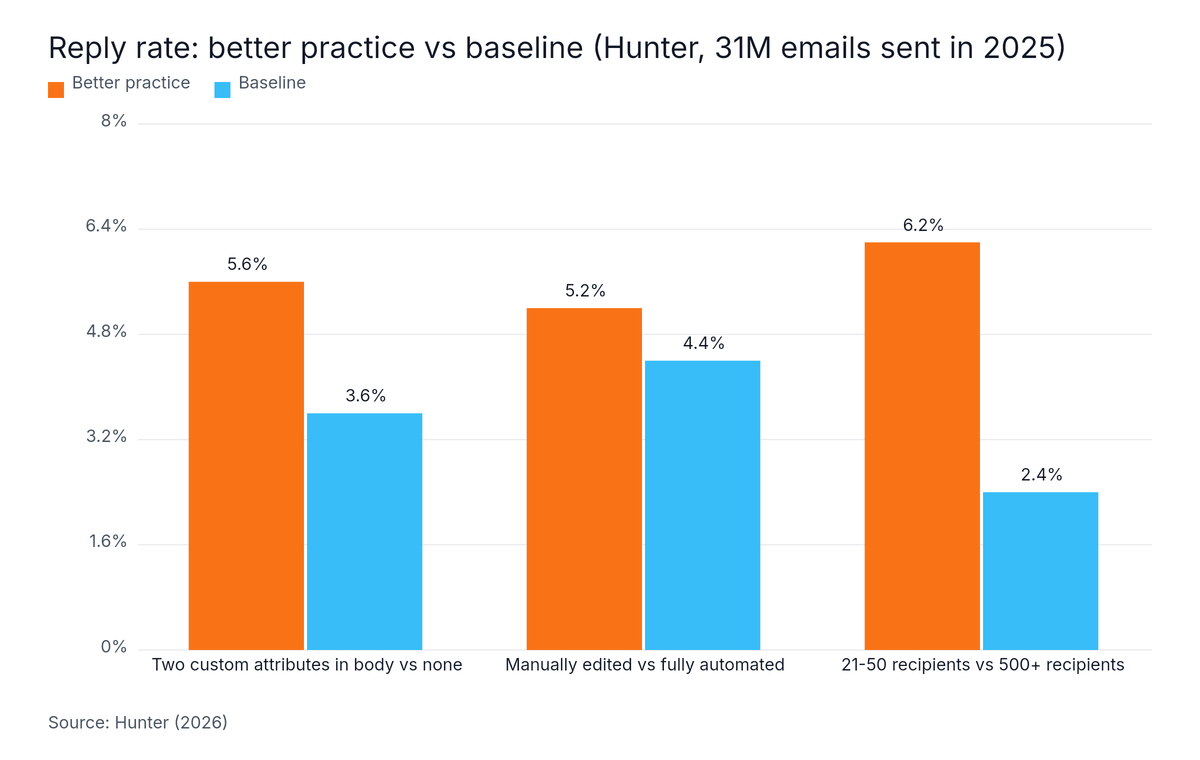
The same 31-million-email dataset shows three practices that beat their baselines, charted below: two custom attributes, manual edits (5.2% vs 4.4%) and batches of 21 to 50 recipients (6.2% vs 2.4%) (Hunter, 2026). These are observational results, not A/B tests.
Grouped Bar chart: Reply rate: better practice vs baseline (Hunter, 31M emails sent in 2025). Highest: 21-50 recipients vs 500+ recipients at 6.2%.
What does personalized cold email outreach look like when you have 500 prospects a week?
At 500 prospects a week, personalized cold email outreach means sorting prospects into tiers and spending human time where it pays back, not writing 500 unique emails. Hunter's analysis of 31 million emails found sequences sent to 21 to 50 recipients reply at 6.2%, against 2.4% for sequences sent to 500 or more (Hunter, 2026).
Weekly paper planner with five columns of cards sorted into three stacks on a desk
Tiered personalization is a method that gives each prospect tier a different level of research and writing effort. The split below is a suggested workflow, not a sourced benchmark. At about 100 prospects a day, effort has to be rationed.
Tier
Who goes here
Trigger needed
How it is written
Human effort
1
Best-fit accounts with a clear, recent signal
Strong, verified
Written or heavily edited by the rep
Highest
2
Good-fit accounts with some signal
Moderate
AI draft built from the signal, then reviewed
A quick review
3
Good-fit accounts with no signal
None yet
Segment-level template with role-specific problem and offer
Spot checks
A weekly workflow you can copy
Pull the week's 500 prospects from your Customer Relationship Management (CRM) system and tag each with a segment.
Split each segment into small batches instead of one 500-person blast.
Assign tiers using the signals you can verify.
Draft tier 2 with AI from the signal, and have a rep review each draft before it sends.
Write tier 1 by hand.
Send tier 3 as a segment-level message with a tailored offer.
Review positive replies and meetings, then adjust the next week's tiers.
Do not skimp on follow-ups. Instantly reports that 58% of replies come from step one and the other 42% from follow-ups (Instantly, 2026). Spend your personalization effort on step one, then make each follow-up add something new.
Did AI-written cold emails lower reply rates because every inbox now looks the same?
The available evidence blames unreviewed AI output, not AI itself, for weak cold email replies. Hunter found manually edited cold emails reply at 5.2%, against 4.4% for fully automated ones (Hunter, 2026), and in Saleshandy's 12,000-send vendor test, AI-only emails replied at 4.1% while AI plus human review reached 14.7% (Saleshandy, 2026).
A typed draft page with a red pencil, an eraser and handwritten marginal notes beside a closed laptop
No clean public causal study exists. Hunter's page does not say whether its automated emails were AI-written, and Saleshandy's test is a vendor's own, not peer-reviewed, with controls that are not visible. Read both as directional.
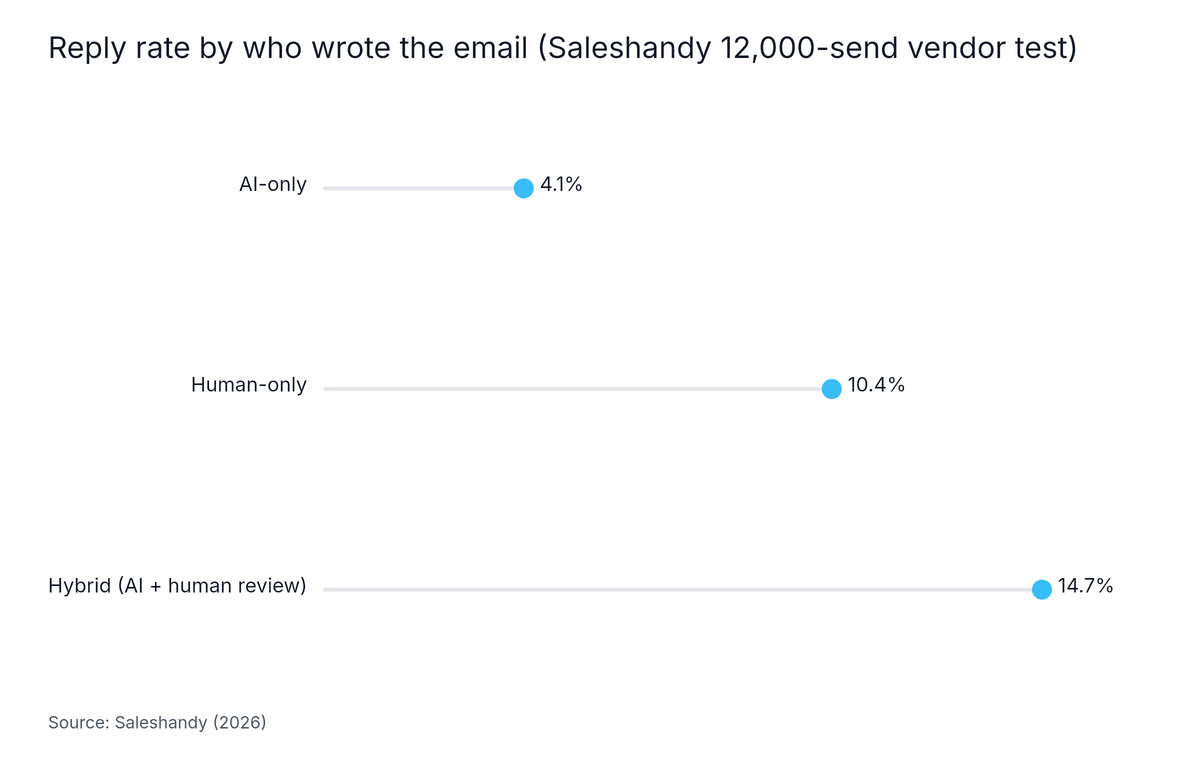
Saleshandy's 2026 test reported 4.1% for AI-only, 10.4% for human-only and 14.7% for a hybrid of AI plus human review, with a 7.3% positive-reply rate for the hybrid (Saleshandy, 2026). That hybrid figure is high compared with the 3% to 6% industry benchmarks, so do not expect to copy it.
Lollipop chart: Reply rate by who wrote the email (Saleshandy 12,000-send vendor test). Highest: Hybrid (AI + human review) at 14.7%.
Buyers react to the feel of the message. Hunter's survey found 69% of decision-makers say it bothers them if AI was used in a cold email, unless the output feels genuinely human (Hunter, 2026). That is a vendor survey, and the sample size for this item was not visible.
Gartner's research points the same way for the wider sales process. Its VP Analyst Robert Blaisdell said "sellers need to show up differently, engaging where they can help buyers validate information, reduce risk and move forward with greater confidence" (Gartner via BizTechReports, 2026). Gartner also reports that 69% of B2B buyers turn to sales reps to validate AI-generated insights. In practice: use AI for research and first drafts, then let a person check facts and tone.
Is AI personalization in cold outreach just a first-line trick, or can it go deeper?
AI personalization in cold outreach can go much deeper than a first line, by changing the trigger, the problem hypothesis, the offer and the follow-up for each segment. Hunter's 2026 data shows a 56% higher reply rate for emails with two custom attributes in the body than for emails with none (Hunter, 2026).
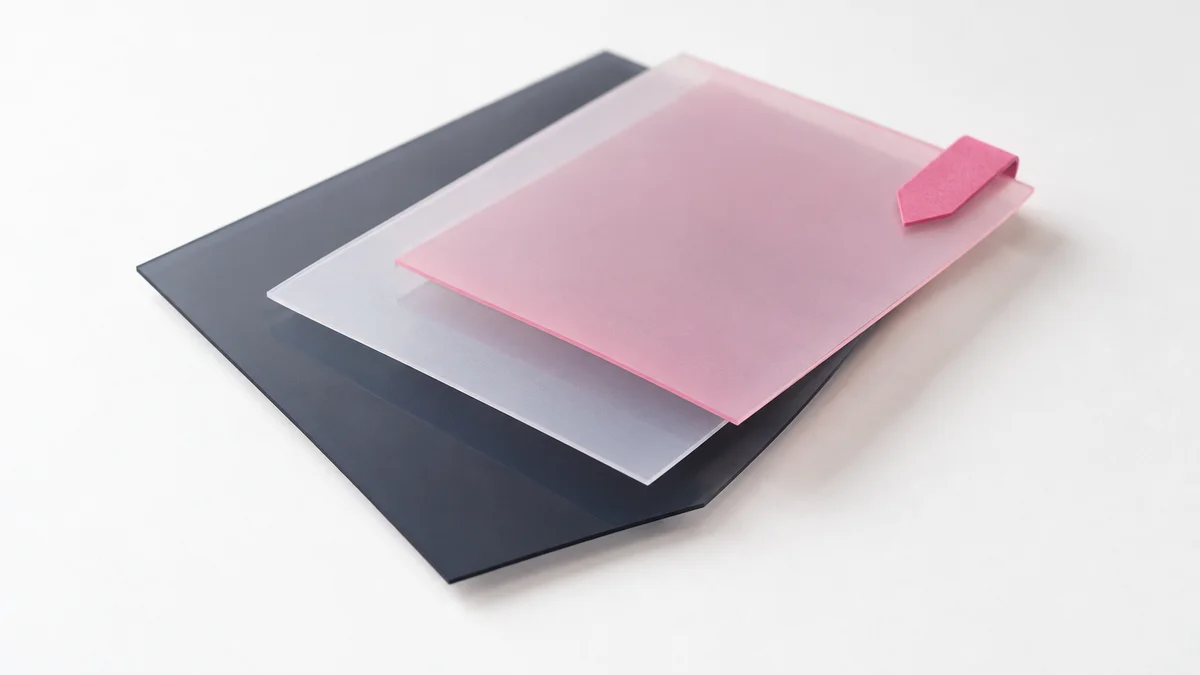
Layered stack of translucent paper sheets with a pink tab showing depth of personalization
Personalization depth is how many parts of an email change per prospect, from the first line to the offer and follow-up. A first-line opener changes one part. The two-attribute result suggests that more parts changing in the body goes with more replies, though the data is observational.
Layer
What changes per prospect
Example input
Best done by
1. Opening line
The first sentence
Recent post or news item
AI, with review
2. Trigger
Why you are writing now
Hire, launch, funding or tool change
AI finds it, a rep confirms it
3. Problem hypothesis
The pain tied to their role
Role and team context
Rep, with AI suggestions
4. Offer and call to action
The ask, matched to the segment
Segment and stage
Rep
5. Follow-up
What each later step adds
Reply behavior, new signals
Rep, with AI drafts
Going deeper with video
A hybrid email is a message drafted with AI and then reviewed or edited by a person before sending. Video is one way to add a layer that text cannot, because the prospect sees a real face and a screen built around their own site. To see how that works without recording each clip, read about sending personalized videos at scale and browse video prospecting examples.
Our data: Potion's GrowPronto case study reports 45 meetings booked and 7 accounts closed (GrowPronto case study).
That is one customer outcome reported by Potion, not an independent benchmark, and it should not be read as a guaranteed result.
What are the limits of this advice, and what can't the data tell you?
The cold email reply-rate advice in this guide has limits: most figures come from vendor platforms and self-selected campaigns, not controlled experiments. Hunter's 2025 report rests on 217 surveyed decision-makers and 11 million emails (Hunter, 2025), and Instantly's average comes from one self-serve platform (Instantly, 2026). They show patterns, not proof of cause.
Keep these caveats in mind:
Instantly's average comes from a self-serve platform and includes a lot of low-effort volume.
Hunter's findings are observational, from campaigns with no control group, and Hunter sells email tools.
Saleshandy's 12,000-send test is a vendor test, and its numbers sit far above other benchmarks.
Benchmarks use different denominators, so a 1% reply rate on total sends is not the same as 1% per recipient.
Teams with very small, high-value account lists, or with domains that already fail authentication, will gain more from fixing those first than from rewriting copy.
Nothing here guarantees a specific lift. Test on one segment before changing the whole program.
Frequently Asked Questions
What is a good cold email reply rate?
A good cold email reply rate depends on how it is measured. Instantly's 2026 benchmark reports a 3.43% platform-wide average, 5.5% for the top quartile and 10.7% for the top 10% (Instantly, 2026). Hunter's 2025 study reports a 4.1% average campaign reply rate (Hunter, 2025). Always check whether a figure divides by recipients or by total sends.
Do AI-written cold emails get lower reply rates than human-written ones?
AI-written cold emails can get lower reply rates when nobody reviews them. In Saleshandy's 2026 vendor test of 12,000 sends, AI-only emails replied at 4.1%, human-only at 10.4% and AI plus human review at 14.7% (Saleshandy, 2026). The test is directional, not peer-reviewed, so treat the gap as a pattern, not a guarantee.
How do I personalize cold emails when I send to 500 prospects a week?
Sort the 500 prospects into tiers and give each tier a different level of effort. Send small segmented batches, draft with AI only where a clear signal exists, and write by hand for the highest-value accounts. Hunter's 2026 data shows batches of 21 to 50 recipients reply at 6.2%, against 2.4% for 500 or more (Hunter, 2026).
Is AI personalization just a first-line trick?
AI personalization is only a first-line trick when it stops at the opening sentence. It can also adapt the trigger, the problem hypothesis, the offer and the follow-up for each segment. Hunter's 2026 data shows emails with two custom attributes in the body get a 56% higher reply rate than emails with none (Hunter, 2026).
Conclusion
A reply rate that fell below 1% usually has a few separable causes. Work through them in order:
Check authentication and inbox placement first, since Gmail and Microsoft now enforce their rules.
Compare yourself to a benchmark with the same denominator.
Personalize the trigger, problem and offer, not only the first line.
Split a 500-prospect week into small, tiered batches.
Put a person between AI drafts and the send button.
For a deeper layer than text, see video email marketing for B2B sales. To test personalized video email on one segment, Start Free Trial with Potion's 7-day trial.
Written by
Carlos Agüero
Carlos Agüero builds tools that help B2B sales teams sell smarter. As part of TargetGrid.ai, Skale.email, and Potion, he's focused on multi-channel outreach automation, inbox deliverability, and AI-powered video. Berkeley Haas COBE. Based in Santiago, Chile. Passionate about helping sales teams close more, faster, with less manual work.

 Carlos AgüeroNov 4, 2026