
Blog
Is Cold Email Legal? US, Canada, UK and Australia Compared
Is cold email legal? Compare CAN-SPAM, CASL, UK PECR and Australia's Spam Act: legal basis, 2026 fines, enforcement cases, footer text and a checklist.

LinkedIn video outreach explained: what the 2026 reply-rate benchmarks show, where video fits in an SDR sequence, and how to A/B test it against text.
 Carlos AgüeroNov 10, 2026
Is cold email legal? Compare CAN-SPAM, CASL, UK PECR and Australia's Spam Act: legal basis, 2026 fines, enforcement cases, footer text and a checklist.

What a video landing page for sales outreach should include: five elements, templates by scenario, benchmarks and a QA checklist for SDR teams.

Why AI automation agency cold outreach fails in 2026: benchmark data, deliverability limits, AI SDR results and a six-step workflow that works.
Request a quote and our experts will contact you within 24 hours with tailored solutions and pricing.
You can also send us a quick email at support@sendpotion.com.
Last updated: Nov 10, 2026
By Carlos Agüero | Last updated October 22, 2026
LinkedIn video outreach is the practice of sending short, personalized recorded videos to prospects through LinkedIn messages, so a Sales Development Representative (SDR) can earn a reply with a face instead of a paragraph. Plain text is fading: the reply rate to connection-request notes fell from 3.5% to 2.2% in twelve months (Expandi, 2026). Yet we found no independent, controlled study that isolates video from text inside LinkedIn messages. Most "2x to 5x" claims trace back to video vendors. This guide separates data from claims, shows how video outreach in cold email differs, and gives you a pilot design to test video yourself.
Key Takeaways
- LinkedIn video outreach works best as a follow-up to a text touch, after a prospect accepts a connection or engages, not as a blind first message.
- No independent study proves that LinkedIn video beats text. The best-sourced benchmark compares InMail at 8.37% with messages to connections at 23.76% (Expandi, 2026), which is a relationship gap, not a format gap.
- LinkedIn reply-rate benchmarks use different denominators, so compare like with like: Belkins reports 7.2% (Belkins, 2026) while HeyReach reports a 22.22% median (HeyReach, 2026).
- A matched A/B pilot of roughly 100 to 150 sends, scored on positive replies or meetings, is the defensible way to prove video works for your team.
- Irrelevant video is still cold outreach: 73% of B2B buyers avoid suppliers who send it (Gartner, 2025).
In this guide
LinkedIn video outreach is the use of short recorded videos, sent through LinkedIn direct messages, InMail or a hosted link, to start or restart a sales conversation. Sales Development Representatives (SDRs) should use it mainly after a prospect accepts a connection or engages, and for high-value accounts, because the biggest LinkedIn drop-off comes after acceptance: typical reply-to-acceptance conversion is 18% (HeyReach, 2026).
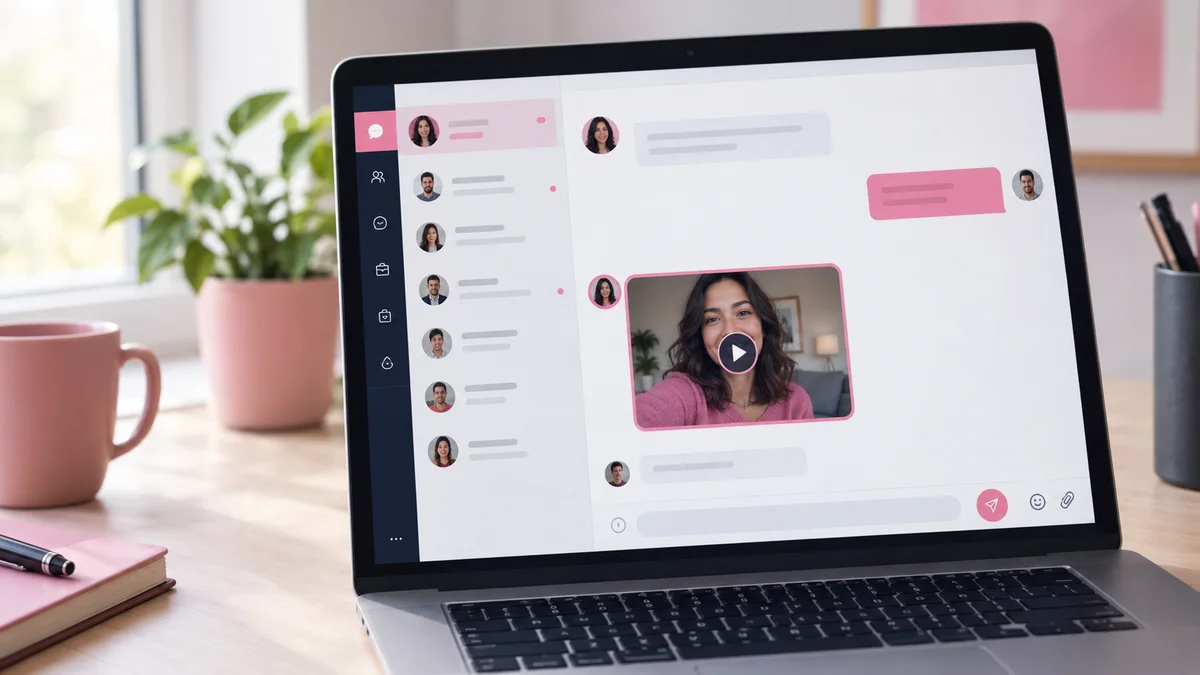
Reply-to-acceptance conversion is the share of accepted connections that go on to reply. HeyReach's 96,051-campaign dataset puts typical acceptance at 21% and typical reply rate at 22%, yet only 18% of people who accept ever reply, so four in five accepters stay silent (HeyReach, 2026). That silent gap is where a video has the most room to help. The vendor frames video as the fix, but the data does not test that framing.
InMail is LinkedIn's paid message format for contacting people outside your network. A direct message to an existing connection is a different surface with different economics, and the difference matters when you compare numbers.
| Format | Typical use | Scales without extra tooling? |
|---|---|---|
| Hosted video link in a direct message | Follow-up after acceptance, with a landing page and call to action | Yes, if generated or templated |
| Native video note recorded in LinkedIn | Quick, informal 1:1 note to a warm contact | No, one recording per prospect |
| Video link inside an InMail | Reaching a prospect outside your network | Limited by InMail credits |
| Tagged video post | Public visibility for a named account | No, one post reaches many |
Video costs minutes per prospect, while text costs seconds. Spend those minutes where the odds are better:
For worked examples of scripts, see video prospecting examples.
LinkedIn video messages probably earn more replies than text InMails for warm, high-value prospects, but no independent, controlled study proves it. The best-sourced numbers compare channel types, not formats: InMail campaigns to Open Profile prospects averaged an 8.37% reply rate against 23.76% for messages to existing connections (Expandi, 2026). Relationship state moves replies more than format does.

Expandi's H1 2026 campaign data covers 7,802 InMail campaigns and 11,530 message campaigns, with no follow-up assumed (Expandi, 2026). A message only exists after a request is accepted, so the roughly 3x gap reflects who you are writing to. Expandi sums it up: "Messages to existing connections get more replies. InMail gets more reach." (Expandi, 2026)
That is the confounder in most video claims. A video sent to a connection will beat a text InMail sent to a stranger, even if the video adds nothing. The "x-fold lift" figures we reviewed come from video-tool vendors, agency anecdotes or unsourced "teams report" text. Treat them as hypotheses.
The warm-versus-cold pattern shows up again in campaign types. Cold email averages 5.1% and all LinkedIn direct messages 10.3%. Inbound-visitor campaigns reach 13.4%, event-attendee campaigns 14.21%, and Messenger campaigns up to 16.86% (Expandi, 2026).
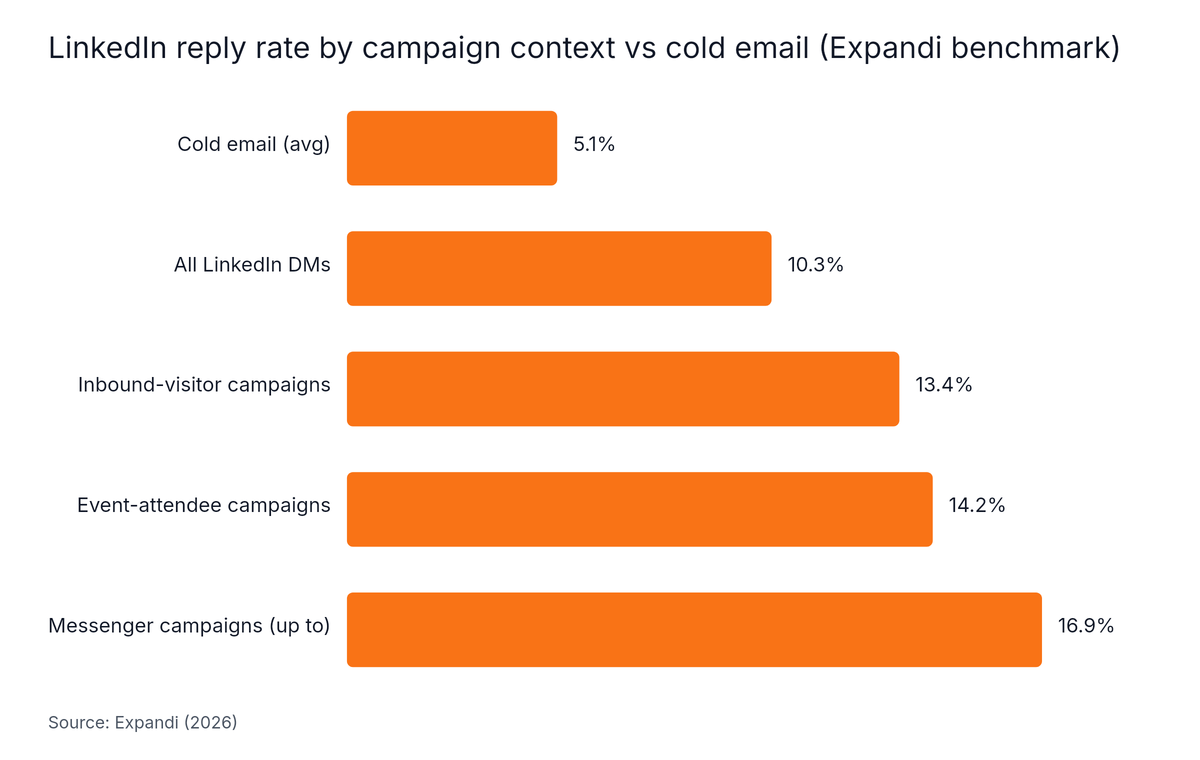
Source: Expandi, 2026
Text-first-touch fatigue is the decline in replies to templated written openers. Across 13.2M connection requests, the reply rate to connection-request notes dropped from 3.5% in May 2025 to 2.2% in April 2026, a 37% relative decline (Expandi, 2026). Platform-wide, 10.4% of outbound LinkedIn messages still get a reply, with Staffing & Recruiting at 18.9% and Computer Software at 8.8% (Expandi, 2026).
This decline is why teams test video: a recorded face is harder to ignore than a template. It is a reason to test, not proof of lift.
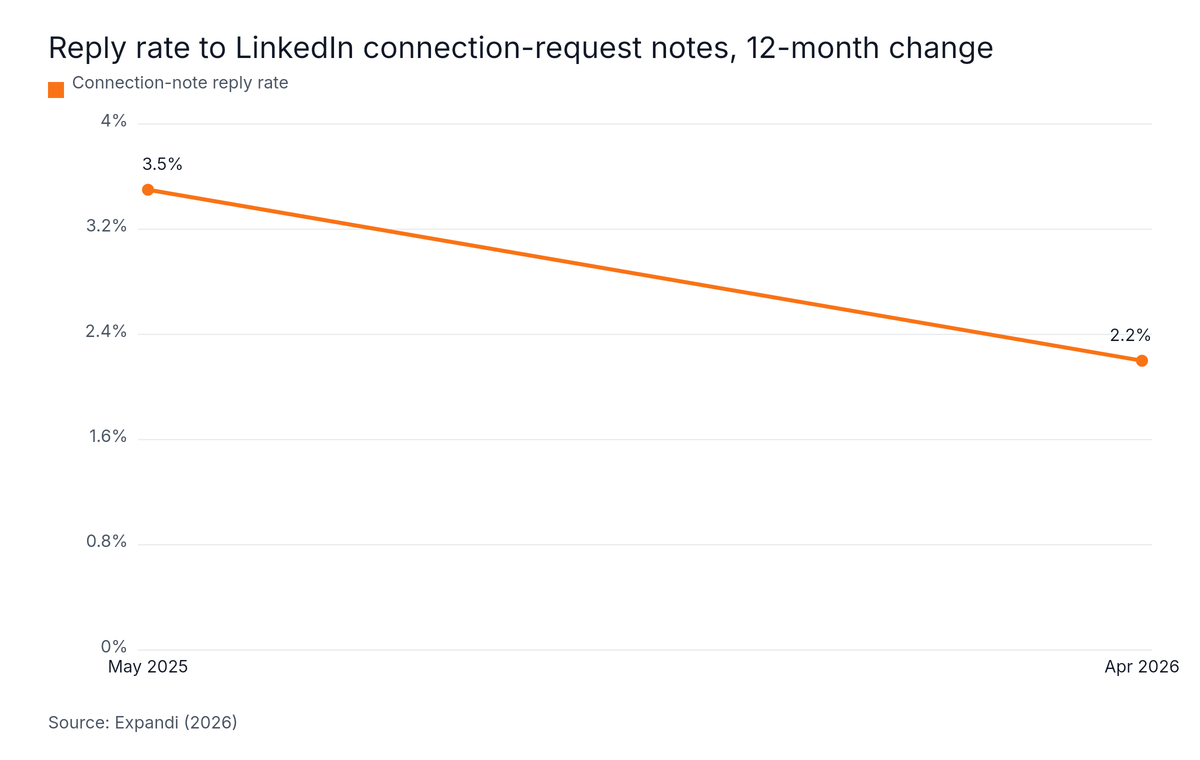
Source: Expandi, 2026
Our data: Potion's customer results include the case study "GrowPronto books 45 meetings and closes 7 accounts with Potion": 45 meetings booked, 7 accounts closed. This is a company case study, not independent research, and it is not specific to LinkedIn, so it does not prove a LinkedIn lift.
LinkedIn video outreach fits best after the first text touch: an SDR connects, sends a short note, then follows up with a personalized video once the prospect accepts or engages. That placement targets the leak in the funnel, where typical reply-to-acceptance conversion is 18%, meaning four of five accepted connections never reply (HeyReach, 2026).
HeyReach states the risk plainly: "A campaign can look healthy on acceptance and still fail completely to generate replies." (HeyReach, 2026) In its 96,051-campaign dataset, 10.7% of campaigns got zero replies (HeyReach, 2026). Acceptance is not the finish line.
| Step | Trigger | Touch | Goal |
|---|---|---|---|
| 1 | Prospect matches your Ideal Customer Profile (ICP) | Connection request, optional short note | Get accepted |
| 2 | Connection accepted | Short text message tied to a real trigger | Start a conversation |
| 3 | No reply, or the prospect engages with content | Personalized video via hosted link | Earn a reply or a click |
| 4 | Video watched, no reply | One text follow-up with a single question | Book a meeting or close the loop |
The step order is editorial guidance, not a tested benchmark. Adapt it to your market, and read the cold-email angle in what video outreach is and whether it works first-touch.
A sensible tiering, again editorial guidance rather than a measured result, splits prospects like this:
HeyReach's benchmark also shows that campaigns run by 6 to 20 senders, a typical SDR-team setup, reach a 25% median reply rate, against 22.22% for a single sender (HeyReach, 2026). That is general campaign data, not video-specific.
Keep it short. Our editorial guidance is under 60 to 90 seconds, a named trigger in the first sentence and one question at the end. Avoid a pitch. In an analysis of 25 million cold emails, Gong Labs found: "Pitching reduces reply rates by as much as 57%." (Gong, 2026) That is email data, but the principle likely transfers to video. For a fuller process, see the video prospecting playbook for SDR teams.
LinkedIn reply-rate benchmarks are comparable only when they share a denominator: replies per message, per conversation started, per accepted connection or per invitation. Published figures run from 7.2% of messages across 15M+ contacts (Belkins, 2026) to a 22.22% median per conversation started (HeyReach, 2026), largely because each divides by something different.
A reply-rate denominator is the base a reply rate is divided by, such as messages sent, conversations started, accepted connections or invitations sent. Mixing denominators is the most common benchmarking error. Use this table to keep them straight:
| Benchmark | Rate | Denominator or context | Source |
|---|---|---|---|
| InMail to Open Profile prospects | 8.37% | Campaign average, 7,802 campaigns | Expandi, 2026 |
| Messages to existing connections | 23.76% | Campaign average, 11,530 campaigns | Expandi, 2026 |
| All outbound LinkedIn messages | 10.4% | Per outbound message, 13.2M-request dataset | Expandi, 2026 |
| Overall LinkedIn outreach | 7.2% | Replies per message sent, 15M+ contacts | Belkins, 2026 |
| Median LinkedIn campaign | 22.22% | Replies per conversation started, 96,051 campaigns | HeyReach, 2026 |
Do not mix the Expandi cohorts: the 8.37% and 23.76% figures use different cohort definitions from the 10.4% platform average.
Industry matters too. Belkins says: "Overall reply rate across 15M+ contacts is 7.2%, but it ranges from 4.2% to 10.5% depending on the industry alone." (Belkins, 2026) Your reference point should be your own industry and your own channel type, not a vendor headline.
Benchmarks describe text-heavy campaigns. None of the sources above isolates video. Use them to spot a broken test, such as a reply rate far below your channel's range, not to predict the lift video will give you.
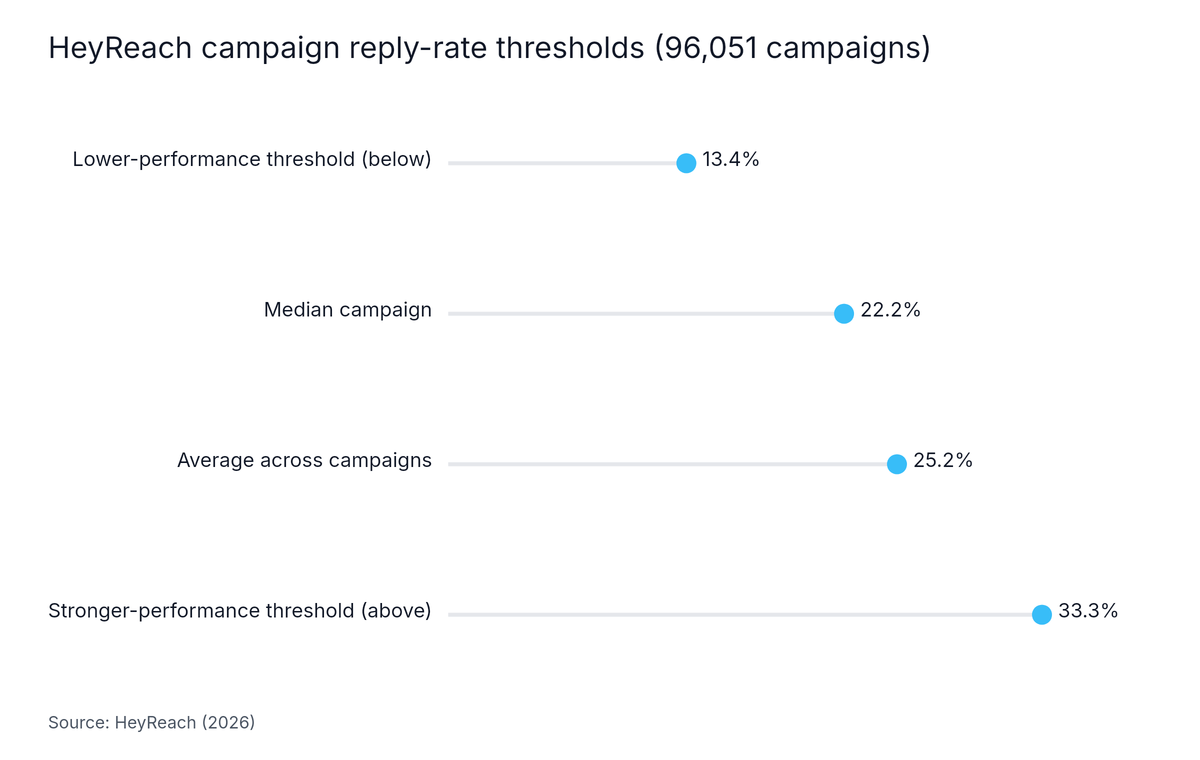
A LinkedIn video versus text A/B test compares both formats on matched prospects, from the same sender, at the same sequence step, and counts positive replies or booked meetings rather than raw replies. Start with a pilot of roughly 100 to 150 sends and sanity-check results against the 22.22% median campaign reply rate (HeyReach, 2026).

At this sample size, only large differences will be visible, so treat a small gap as inconclusive.
HeyReach's benchmark gives practical guardrails. Its median campaign reply rate is 22.22% and the average across campaigns is 25.19%. Campaigns below a 13.37% reply rate sit in the lower-performance band, and those above 33.33% in the stronger one (HeyReach, 2026). The rate there is replies divided by conversations started, so compare your pilot on the same basis.
Source: HeyReach, 2026
Fitting LinkedIn video into the Customer Relationship Management (CRM) and multichannel stack means treating video as one step in a sequence: a trigger fires, a video is sent, and the reply is logged back. The step matters because typical reply-to-acceptance conversion is only 18% (HeyReach, 2026), so video belongs where replies leak.
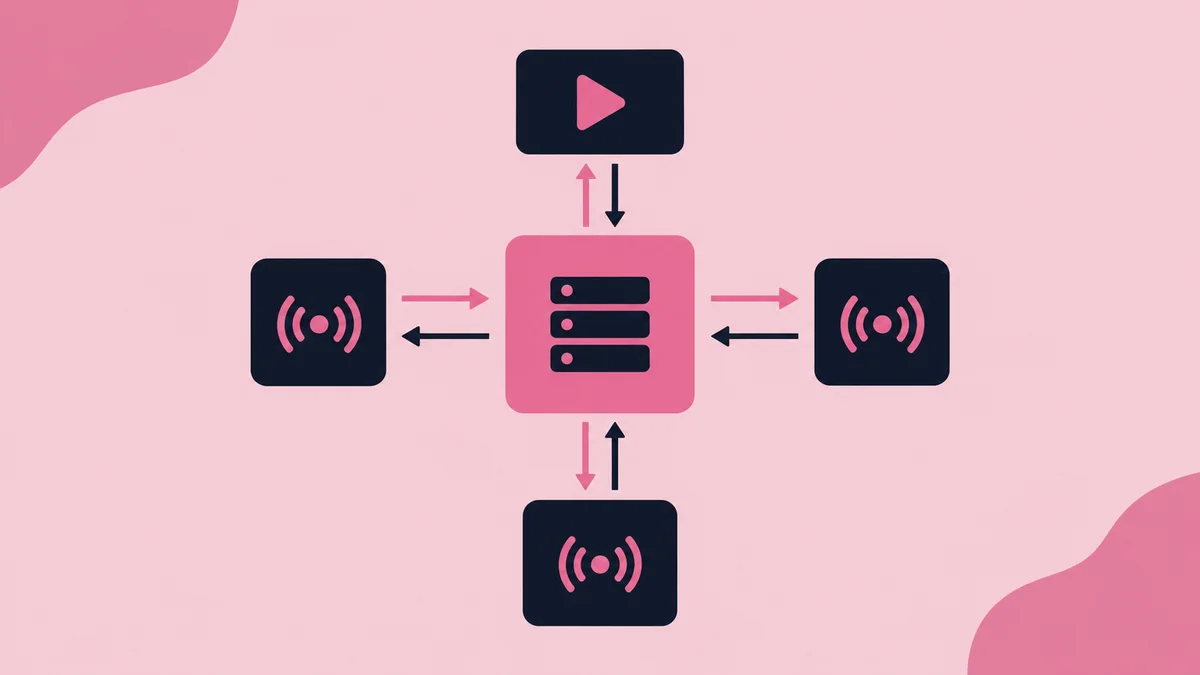
A dynamic screen recording is a screen capture whose background changes for each prospect, for example by showing the prospect's own website or LinkedIn profile. It lets one recording read as a bespoke walkthrough.
| Approach | Effort per prospect | Fit |
|---|---|---|
| Manual 1:1 recording | One recording per prospect | Top-tier accounts and champions |
| AI-generated from one master recording | One recording for the whole list | Mid-tier accounts and re-engagement |
| Text only | Seconds | Long tail without a signal |
Potion is an AI video platform that generates personalized videos in bulk using a rep's own face, voice and gestures. Its published specifications list CSV upload for bulk generation and CRM triggers for automated sends, with native workflows for HubSpot, Salesforce, Outreach, Salesloft and Apollo.
Our data: Potion's claimed benchmark is about 15 hours per rep per week saved on manual recording. This is a company benchmark, not independent research.
For the mechanics of scale, read how to send personalized videos at scale, and compare options in best video prospecting tools for SDR teams.
LinkedIn video outreach is not the right move when the prospect is cold and the message is a pitch, when the video is irrelevant, or when you cannot yet measure replies. Gartner's survey found 73% of B2B buyers actively avoid suppliers who send irrelevant outreach (Gartner, 2025), so relevance matters more than format.
SDRs use video for LinkedIn prospecting as a follow-up touch: they connect, send a short text note, then record or generate a brief personalized video that names a trigger and ends with one question. Teams usually reserve manual 1:1 videos for top-tier accounts and use AI-generated versions for the wider list. Campaigns run by 6 to 20 senders show a 25% median reply rate (HeyReach, 2026, general campaign data, not video-specific).
A good LinkedIn reply rate in 2026 depends on the denominator, but about 10.4% of outbound messages getting a reply is the platform-wide average (Expandi, 2026). Belkins reports 7.2% across 15M+ contacts, ranging from 4.2% to 10.5% by industry (Belkins, 2026), while the HeyReach median campaign sits at 22.22% per conversation started (HeyReach, 2026).
An SDR should send a LinkedIn video after the first text touch, usually once the prospect accepts the connection or engages with content. That timing targets the post-acceptance gap, where typical reply-to-acceptance conversion is 18% (HeyReach, 2026). Sending video as a cold first message is possible, but no independent data shows it outperforms text at that step.
AI-personalized video can hurt trust on LinkedIn when it is irrelevant or looks glitchy, and no independent study measures the effect directly. Gartner found 73% of B2B buyers actively avoid suppliers who send irrelevant outreach (Gartner, 2025). Use your own face and voice, name a real trigger, and test a small batch before you scale.
A LinkedIn prospecting video should usually run under 60 to 90 seconds, open with a named trigger and end with one question. That length is editorial guidance, not a tested benchmark or a cited study. Platform limits for native LinkedIn video notes vary by surface and change over time, so check LinkedIn Help before you build a script.
LinkedIn video outreach is a promising follow-up format, not a proven multiplier. Carry these points forward:
To see how this plays out in a real stack, start with the video prospecting playbook. When you are ready to test generated video on a small list, Start Free Trial and generate AI videos in your own face, voice, and gestures at scale.
Written by
Carlos Agüero
Carlos Agüero builds tools that help B2B sales teams sell smarter. As part of TargetGrid.ai, Skale.email, and Potion, he's focused on multi-channel outreach automation, inbox deliverability, and AI-powered video. Berkeley Haas COBE. Based in Santiago, Chile. Passionate about helping sales teams close more, faster, with less manual work.
| Connection-request notes | 2.2% | Per note, April 2026 | Expandi, 2026 |