
Blog
Is Cold Email Legal? US, Canada, UK and Australia Compared
Is cold email legal? Compare CAN-SPAM, CASL, UK PECR and Australia's Spam Act: legal basis, 2026 fines, enforcement cases, footer text and a checklist.

Evaluate sales video software with a repeatable bake-off: volume limits, a text-only control, reply-rate thresholds, CRM sync and EU AI Act checks.
 Carlos AgüeroOct 25, 2026

Is cold email legal? Compare CAN-SPAM, CASL, UK PECR and Australia's Spam Act: legal basis, 2026 fines, enforcement cases, footer text and a checklist.

What a video landing page for sales outreach should include: five elements, templates by scenario, benchmarks and a QA checklist for SDR teams.

Why AI automation agency cold outreach fails in 2026: benchmark data, deliverability limits, AI SDR results and a six-step workflow that works.
Request a quote and our experts will contact you within 24 hours with tailored solutions and pricing.
You can also send us a quick email at support@sendpotion.com.
sendpotion.com
Last updated: Oct 25, 2026
By Carlos Agüero, a Berkeley Haas graduate who builds outreach automation, inbox deliverability and AI video tools for B2B sales teams through TargetGrid.ai, Skale.email and Potion. Disclosure: Potion is the product from SendPotion, the publisher of this guide.
Sales video software is a platform that lets reps record or generate personalized prospect videos and send them inside outreach sequences; evaluating it means testing finalists on identical scripts, lists and sequences. Most buyers skip that step. 87% of sales organizations already use some form of AI (Salesforce, 2026), so every vendor demo looks polished, and polish is not pipeline. You need a tool that survives volume, reaches the inbox and beats the plain-text email you send today. This guide gives you a repeatable bake-off, volume tests, pilot thresholds and compliance checks. If you still need finalists, start with this shortlist of video prospecting tools.
Key Takeaways
- Sales video software should be tested head to head: the same script, list split and sequence across three finalists, plus a text-only control group.
- Volume claims need proof, so test batch render time for 500+ videos, monthly credit caps, CSV or API limits and what happens when a sequencer triggers many videos at once.
- The text baseline is low: Hunter reports a 3% average reply rate for sales outreach sequences (Hunter, 2026), so measure your own lift instead of trusting vendor claims.
- EU AI Act Article 50 transparency rules have applied since 2 August 2026, so ask every sales video vendor how it labels AI-generated and voice-cloned video.
- Judge a sales video pilot on meetings booked and reply rate, not on video views.
Sales video software is a platform that helps reps put a face and a personal message in front of prospects, either by recording one video at a time or by generating many versions from a single recording. Sorting tools by how they make video comes first, because the text baseline is low: Hunter reports a 3% average reply rate for sales outreach sequences (Hunter, 2026).

Most products you will see in a shortlist fall into one of three groups. The table shows how each group makes video and where it tends to break.
| Type | How each video is made | Where volume is capped | Test first |
|---|---|---|---|
| One-to-one recording | A rep films every video by hand | Rep hours per day | Time per video, including edits |
| AI facecam personalization | One facecam recording is cloned into many versions | Render time and monthly credits | Lip-sync accuracy and batch speed |
| Dynamic screen recording | A screen capture with a different background per prospect | Render time and data quality | Whether the right website or profile loads |
AI facecam personalization is a method that turns one facecam recording into many versions, each greeting a different prospect by name. A dynamic screen recording is a screen capture whose background changes per prospect, such as scrolling that prospect's own website. Both depend on merge data, so a wrong name or wrong company shows up on video, where it is harder to forgive than in text.
Sales video software that relies on hand recording is capped by rep hours. Do not guess the cap: have two of your reps film ten prospect videos each, time every one from first take to send-ready, and use that average as your manual baseline. Generated video removes the ceiling but adds new risks: glitches, uncanny output and compliance questions. Your pilot should test both the creative result and the machinery behind it. For background on how video fits cold email, see this guide to video email marketing for B2B sales.
Sales video tools let reps send hundreds of personal videos a week only when the platform generates each video from one master recording, accepts a CSV upload or Customer Relationship Management (CRM) trigger, and renders batches without rep effort. Recorders cap out at what a rep can film. Test batch render time, credit caps and sequencer bursts before trusting any volume claim.

Vendor pages describe scale in adjectives. Few buyers ask for numbers. Automation is moving into sales fast: 54% of sellers say they've used agents, and nearly 9 in 10 plan to by 2027 (Salesforce, 2026). Expect vendors to pitch videos that generate the moment a contact enters a sequence. Adam Alfano, EVP of Sales at Salesforce, framed the goal this way: "We want to kill the busywork so our teams can focus on what actually moves deals forward: building relationships and driving success" (Salesforce, 2026). Busywork removal only counts if the tool holds up at your real volume.
Run these tests during the trial, not after the contract. Write the pass signal down before you start.
| Test | How to run it | Pass signal |
|---|---|---|
| Batch render time | Upload one CSV of 500+ rows and time it to the last finished video | All videos ready before your next planned send window |
| Monthly credit caps | Ask for the cap in writing and count videos you would send in a month | Cap covers your plan with room for retries |
| CSV and API limits | Try the largest file you would ever upload | No row limit, timeout or silent drop |
| Sequencer burst | Enroll many contacts at once in your sequencer | Every contact gets a working video link |
| Bad data handling | Include blank and misspelled fields on purpose | The tool flags errors instead of rendering them |
| Pricing model | Model cost per seat and per video at your volume | You can state cost per sent video |
Per-seat pricing rewards heavy senders. Per-video or per-credit pricing rewards light ones. Neither is wrong, but the difference can swing your cost per meeting. Calculate both at your expected weekly volume and at double that volume. For the mechanics of sending without filming each clip, read how to send personalized videos at scale.
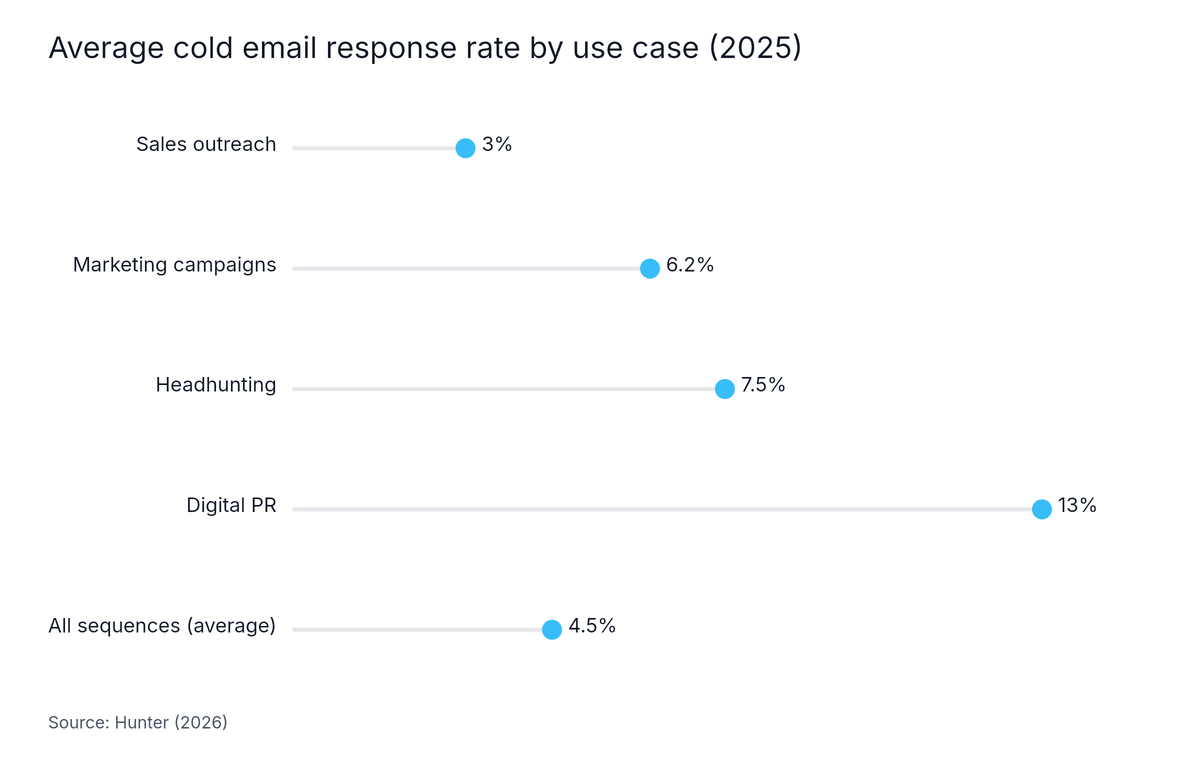
A video pilot should beat the text-only email baseline your team already sends, and published averages are low. Hunter reports a 4.5% average cold email sequence reply rate and 3% for sales outreach (Hunter, 2026), while Belkins measured 0.50% falling to 0.40% across 2025 (Belkins, 2026). Measure your own control group rather than trusting a vendor's lift claim.
Source: Hunter, 2026
Reply rate is the share of sent emails that receive a response. Hunter's data for 2025 puts sales outreach sequences at 3%, below marketing campaigns at 6.2%, headhunting at 7.5% and digital PR at 13%, with 4.5% as the average across all sequences (Hunter, 2026). Your use case sets your baseline, so a benchmark from another use case will mislead you.
Belkins' numbers come from its own campaigns, more than 7.5 million cold emails sent in 2025. The first half averaged a 0.50% reply rate and the second half dropped to 0.40%, a 20% decline within the same year (Belkins, 2026). The two sources differ because they measure different senders. Pick one as context and rely on your own data for the decision.
A control group is a slice of the list that receives the same sequence as plain text, with no video. Without one, you cannot separate the effect of video from list quality, timing or a tougher spam filter. Vendor-circulated lift claims travel from blog to blog, and no independent, controlled study of video reply-rate lift turned up in this guide's research. Treat any multiplier you see as a hypothesis. For a deeper look at first-touch video, see what video outreach is and whether it works in cold email.
Test three finalist AI video tools on the same script, the same list split into equal groups, the same sequence and a text-only control, then score each on reply rate, meetings booked, rep minutes per video and deliverability. Instantly puts the average cold email reply rate at 3.43% (Instantly, 2026), so every finalist must beat your control, not a benchmark alone.

A bake-off is a side-by-side test of finalist tools under identical conditions. Follow these steps so no tool gets an unfair edge.
Keep the groups large enough that a handful of replies cannot swing the outcome. If your list is too small for four groups, test two finalists instead of three.
Use one scorecard for all three finalists so the final discussion rests on numbers.
| Criterion | What to measure | Where to record it |
|---|---|---|
| Reply rate | Replies divided by emails sent, per group | Sequencer report |
| Meetings booked | Booked meetings per group | CRM |
| Rep time per video | Minutes from list upload to send-ready | Stopwatch log |
| Batch render time | Time to finish a full batch | Tool dashboard |
| Deliverability | Inbox placement of video emails versus control | Seed inbox test |
| CRM write-back | Whether views, watch time and clicks land on the contact | CRM record check |
| Video quality | Lip-sync errors, glitches and wrong merge data in a sample | Manual review |
| Admin and security | Permissions, retention, SOC 2 report | Vendor documents |
For ideas on running video inside every sequence step, the video prospecting playbook walks through the workflow.
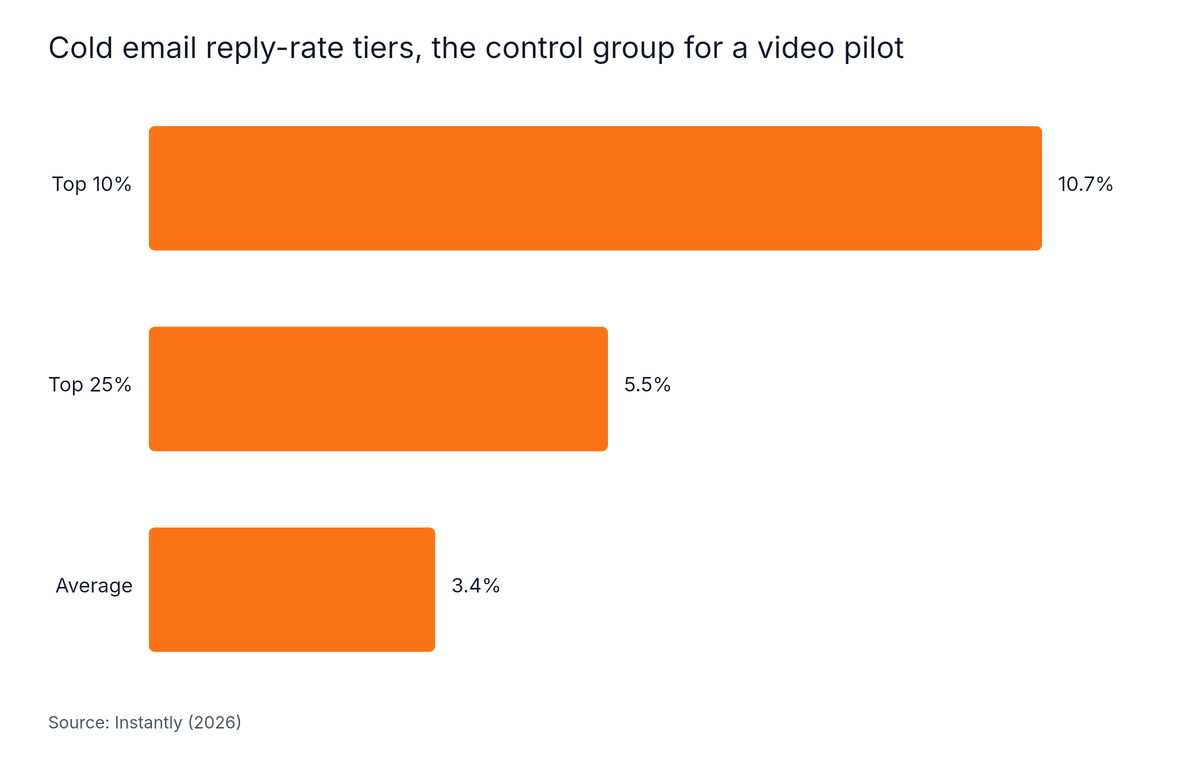
Set video pilot thresholds before the first send, using published reply-rate tiers as targets. Instantly's 2026 benchmark report puts the top 10% of cold email at a 10.7%+ reply rate, the top 25% at 5.5%+ and the average at 3.43% (Instantly, 2026). Write a floor and a stretch target down, then judge each tool against your own control.
Source: Instantly, 2026
Instantly says it analyzed billions of cold email interactions to build these tiers. The numbers give a sales leader a sensible range for the pilot. Use them like this:
| Tier | Reply rate (Instantly, 2026) | How to use it in the pilot |
|---|---|---|
| Top 10% | 10.7%+ | Stretch target, treat a hit as exceptional |
| Top 25% | 5.5%+ | Strong result worth scaling |
| Average | 3.43% | Floor: a video group below this and below your control fails |
Views and watch time are useful diagnostics, but they do not pay quota. Make meetings booked the tiebreaker. A tool that wins on replies but loses on meetings may be attracting curiosity, not buyers.
Our data: Potion's case study "GrowPronto books 45 meetings and closes 7 accounts with Potion" reports 45 meetings booked and 7 accounts closed. Its flagship case study is titled "SAP closes USD500K+ with Potion's AI-generated videos". These are company-reported results, not independent research.
A sales video tool should pass four checks before rollout: consent for any cloned face or voice, a SOC 2 security report, a Data Processing Agreement, and a rep policy that covers AI disclosure under EU AI Act Article 50. Article 50 transparency rules have applied since 2 August 2026 (Paul Weiss, 2026).

EU AI Act Article 50 sets transparency duties for AI interaction and AI-generated content. The law firm Paul Weiss summarizes the point plainly: "Article 50 requires transparency about AI, it does not restrict what AI can be used for." (Paul Weiss, 2026). Generative systems already on the market have until 2 December 2026 for machine-readable marking.
The European Commission published its final Article 50 guidelines on 20 July 2026. The final Code of Practice on marking and labelling AI-generated content followed on 10 June 2026 (ActuIA, 2026). If you sell to EU prospects, ask each vendor how it marks and labels AI-generated or voice-cloned output. This is general information, not legal advice.
Gartner's May 2026 survey found that 69% of B2B buyers turn to sales reps to validate AI-generated insights, and 45% used GenAI in a recent purchase (Gartner via Business Wire, 2026). Buyers want self-service, but they still want a person to confirm what AI told them. Test whether your generated videos make a real rep easy to reach.
Integrations decide whether sales video software works in your real workflow, so test each finalist inside the sequencer your reps already use, whether Outreach, Salesloft, Apollo, HubSpot or Salesforce. Confirm that sends trigger automatically, that video links reach the inbox, and that view events, watch time and CTA clicks write back to the contact record.

Cold email is getting harder to land. Belkins measured reply rates falling from 0.50% to 0.40% across 2025 (Belkins, 2026), so a tool that harms inbox placement can erase any gain from video. Run these checks:
Many pages skip this. A video tool that cannot log views and clicks to the right contact leaves reps guessing who to call. Open ten records after the pilot and check that each shows the video, the view and the click. For a broader comparison of tools by workflow, see this guide to video messaging software for sales teams.
A three-way sales video bake-off is not worth running for a team sending only a handful of videos a week, and no pilot proves long-term lift. Belkins measured a 20% drop in reply rates within 2025 (Belkins, 2026), so small lists and shifting baselines make results noisy. Your own control group is the only evidence that counts.
A single sequence on one segment says little about other segments, other seasons or the novelty wearing off. Independent, controlled studies of video reply-rate lift are missing from the public record, and spam-filter rules keep shifting. Re-run a smaller test each quarter. This guide is general information, so involve legal and security reviewers before you upload prospect data.
The best sales video platform is the one that beats your own text-only control on reply rate and meetings booked at the volume your team actually sends. No independent study ranks platforms, so run a three-way test with the same script, list split and sequence, then check sequencer integration, render limits and AI-disclosure support before you sign.
The best video platform for sales outreach generates personalized videos in bulk from a CSV or CRM trigger, sends inside your existing sequencer, and syncs view and click data back to your CRM. For high-volume SDR teams, AI generation from one recording scales. For a short list of top accounts, one-to-one recording can still fit.
Compare AI video tools for a sales team on reply rate, meetings booked, rep minutes per video, batch render time, deliverability, CRM write-back, video quality and compliance. Use the same script, the same list split into equal groups and a text-only control group, and set pass thresholds before the first email goes out.
Sales teams selling to EU prospects should disclose AI-generated or voice-cloned video, because EU AI Act Article 50 transparency obligations have applied since 2 August 2026. Generative systems already on the market have until 2 December 2026 for machine-readable marking. This is general information, not legal advice, so have counsel confirm your wording.
Personalized video may raise reply rates, but no independent, controlled study of video reply-rate lift was found in this guide's research (2026), and vendor lift claims circulate without primary sources. The reliable way to know is a split test against a text-only control group on your own list, measured on replies and meetings booked.
Choosing sales video software comes down to evidence you collect yourself. Run the same test on every finalist and let the numbers decide.
Ready to put a finalist through the test? Start Free Trial and run your first batch against a text-only control. Then compare your results with these video prospecting examples that got replies.
Written by
Carlos Agüero
Carlos Agüero builds tools that help B2B sales teams sell smarter. As part of TargetGrid.ai, Skale.email, and Potion, he's focused on multi-channel outreach automation, inbox deliverability, and AI-powered video. Berkeley Haas COBE. Based in Santiago, Chile. Passionate about helping sales teams close more, faster, with less manual work.