
Blog
Is Cold Email Legal? US, Canada, UK and Australia Compared
Is cold email legal? Compare CAN-SPAM, CASL, UK PECR and Australia's Spam Act: legal basis, 2026 fines, enforcement cases, footer text and a checklist.

SDR prospecting basics for SaaS teams: how a new SDR starts, plus 2026 benchmarks for meetings, email replies and cold calls to set realistic goals.
 Carlos AgüeroNov 5, 2026

Is cold email legal? Compare CAN-SPAM, CASL, UK PECR and Australia's Spam Act: legal basis, 2026 fines, enforcement cases, footer text and a checklist.

What a video landing page for sales outreach should include: five elements, templates by scenario, benchmarks and a QA checklist for SDR teams.

Why AI automation agency cold outreach fails in 2026: benchmark data, deliverability limits, AI SDR results and a six-step workflow that works.
Request a quote and our experts will contact you within 24 hours with tailored solutions and pricing.
You can also send us a quick email at support@sendpotion.com.
Last updated: Nov 5, 2026
By Carlos Agüero, B2B sales tools builder.
Sales Development Representative (SDR) prospecting is the daily work of finding, researching and contacting buyers who fit your Ideal Customer Profile (ICP), so account executives receive qualified meetings instead of cold lists. It is also the part of sales where vague goals do the most damage.
Most new reps start with a lead list and a quota, then guess at the rest. The result is plenty of activity and little proof of what works. This guide gives you a first-week plan and 2026 benchmarks for meetings, email replies and calls, with the denominators spelled out. It also shows how to stage goals during ramp and where video prospecting fits.
Key Takeaways
- SDR prospecting is outbound work that ends in a qualified meeting for an account executive, so goals should start with outcomes, not activity.
- Only 60% of SDRs are at or above quota, the lowest share in the study's history (The Bridge Group, 2025).
- The average B2B cold email reply rate is 3.43% (Instantly, 2026), and the industry cold call success rate is 2.7% of conversations (Cognism, 2026).
- Every SDR benchmark depends on its denominator: per email sent, per conversation, per prospect reached. State yours before you set a target.
- New SDRs ramp in about 3.0 months on average (The Bridge Group, 2025), so stage their goals instead of assigning full quota on day one.
In this guide
SDR prospecting is the outbound work a Sales Development Representative (SDR) does to find buyers who match the Ideal Customer Profile (ICP), contact them by email, phone, LinkedIn or video, and book a meeting for an account executive. The SDR owns the first conversation, not the close, and the global median quota is 10 held meetings per month (The Bridge Group, 2025).

An Ideal Customer Profile (ICP) is a description of the type of company and buyer most likely to benefit from your product and to buy it. In a SaaS team it usually covers company size, industry, tech stack and the job titles that feel the pain. A weak ICP is a common reason a new SDR's outreach gets ignored.
Prospecting is the part of the sales process before a conversation exists: researching accounts, picking contacts and starting contact. Channel choice matters less than strategy. In its 2026 cold calling report, Cognism says "it’s not the channel that’s broken" (Cognism, 2026). Its point is that targeting and approach decide results, not the medium.
A Business Development Representative (BDR) does outbound work similar to an SDR's, and many companies use the two titles interchangeably. Where firms split them, BDRs usually focus on outbound to new accounts while SDRs also work inbound leads. Read the job description, because the split varies by company.
A new SDR starts prospecting by getting clear on the Ideal Customer Profile (ICP), building a tight list of accounts and contacts, writing one short message per channel, and running a repeatable sequence while tracking replies and meetings. Start narrow, measure what happens, and widen only after the first sequence earns replies.

Before you buy anything, compare options against your actual sequence. The shortlist of video prospecting tools is organized by use case.
Good SDR goals put outcomes above activity: meetings held, accepted opportunities and pipeline come first, while emails sent and dials stay as diagnostic guardrails. The Bridge Group's 2025 study of 351 B2B companies (The Bridge Group, 2025) found the share of SDRs at quota fell to 60%, the lowest in its history, so set attainment targets realistically.
Kevin Warner, founder of the outsourced SDR agency Leadium, puts the risk plainly: "Activity is easy to measure and easy to game, which is why teams over-index on it." (Leadium, 2026). A goal system that rewards dials alone invites low-quality contacts. Treat activity as a signal that something is off, not as the score.
| Tier | Metric | Role | How to use it |
|---|---|---|---|
| Outcome | Pipeline sourced | Primary goal | Tie to Annual Contract Value (ACV) and segment |
| Outcome | Opportunities accepted by account executives | Primary goal | Tests whether meetings were qualified |
| Outcome | Meetings held | Primary goal | Counts only meetings that actually happened |
| Leading | Meetings booked | Secondary goal | Early signal, watch the show rate |
| Diagnostic | Reply rate, conversations per prospect reached | Guardrail | Explains why outcomes moved |
| Diagnostic | Emails sent, dials made | Guardrail | Flags volume or list problems, not success |
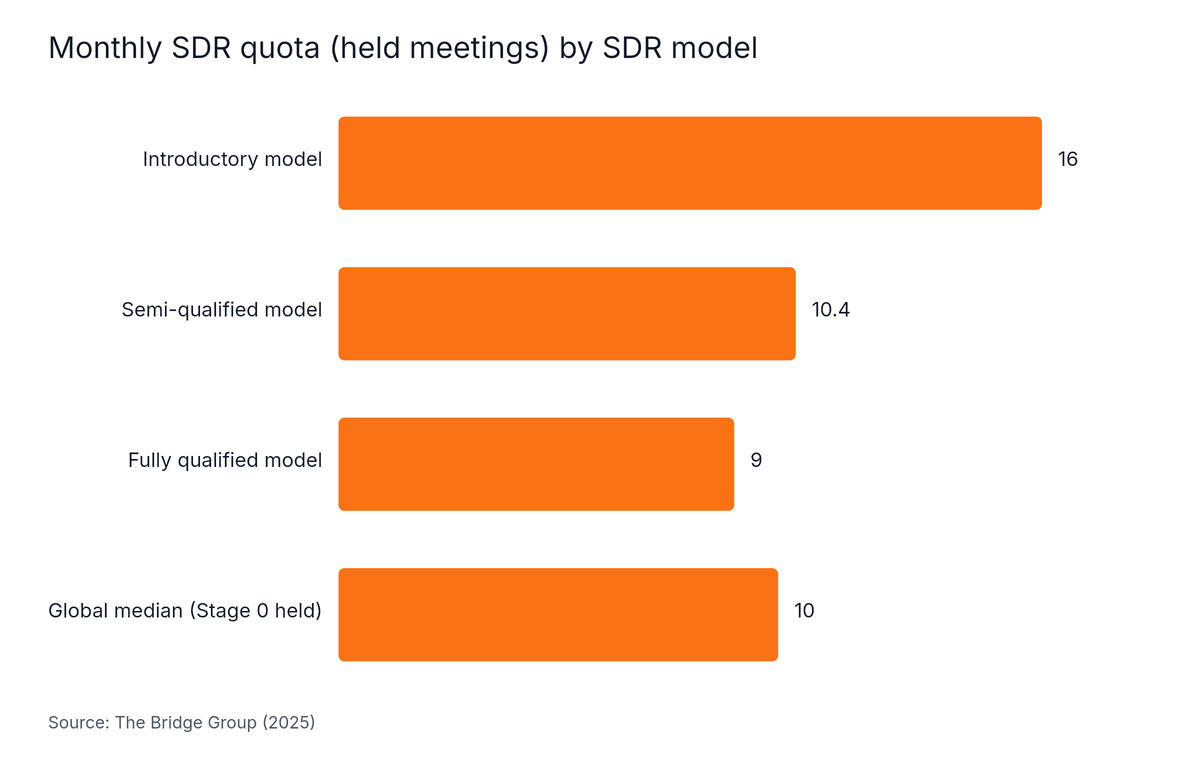
The global median monthly quota is 10 held meetings (Stage 0), down 40% since 2018 (The Bridge Group, 2025). Respondents use their own stage definitions, so the number moves with how deeply SDRs qualify.
| SDR model | Monthly quota (held meetings) | What it means for goals |
|---|---|---|
| Introductory | 16.0 | Lighter qualification, more volume |
| Semi-qualified | 10.4 | Balanced qualification and volume |
| Fully qualified | 9.0 | Deeper discovery, fewer meetings |
| Global median (Stage 0 held) | 10 | Planning anchor for a first quarter |
Source: The Bridge Group, 2025
The deeper the qualification you ask for, the fewer meetings you should expect. Attainment is also uneven. The majority of companies, 67%, report that 50-89% of reps are at quota (The Bridge Group, 2025), so a plan that assumes every rep reaches 100% is unrealistic.
Measure the goal on meetings held and keep meetings booked as an early signal. The Bridge Group states its median quota in held meetings (The Bridge Group, 2025), and a booked meeting that never happens adds no pipeline. Watch the gap between the two as your show-rate check.
Median pipeline sourced per SDR rose from $2.83M in 2022 to $3.78M (The Bridge Group, 2025). The report explains why: "The increase reflects higher ASPs ($44K median in 2024 vs. $27K in 2022) rather than more meetings." (Matt Bertuzzi, The Bridge Group, 2025). Average Selling Price (ASP) drove the gain, not extra meetings. For a team with high ACV, a pipeline goal can be fairer than a raw meeting count. The figure is raw pipeline, not closed-won revenue.
Start from held meetings and divide by each step's conversion rate. The table shows which benchmark to compare against at each step. Where no verified benchmark exists, use your own measured number rather than a guess.
| Funnel step | Question to answer | Benchmark to compare | Source |
|---|---|---|---|
| Held meetings | How many does one rep need per month? | 10 global median | The Bridge Group, 2025 |
| Show rate | What share of booked meetings happen? | Your own CRM data | None verified |
| Email route | How many sends per reply? | 3.43% average reply rate | Instantly, 2026 |
| Phone route | How many conversations per booked meeting? | 2.7% success rate | Cognism, 2026 |
| Accepted opportunities | How many held meetings does sales accept? | Your own CRM data | None verified |
This is arithmetic on benchmarks, not a promise. Measure your own conversion at each step and adjust.
Instantly's 2026 Cold Email Benchmark Report puts the average B2B cold email reply rate at 3.43%, with the top quartile above 5.5% (Instantly, 2026). A good goal for a new SaaS SDR is to land near that average on a clean list, then push toward the top quartile. Always state whether auto-replies are counted.

The same report shows an average open rate of 27.7% (Instantly, 2026). It is vendor platform data, and its method counts all replies per email sent, including auto-replies. A secondary page summarizing the report puts the top 10% of senders at 10.7% or more (Unify, 2026). Treat that as a ceiling, not a target. Reply rate is the share of sent emails that receive a response, and your goal should name which responses count.
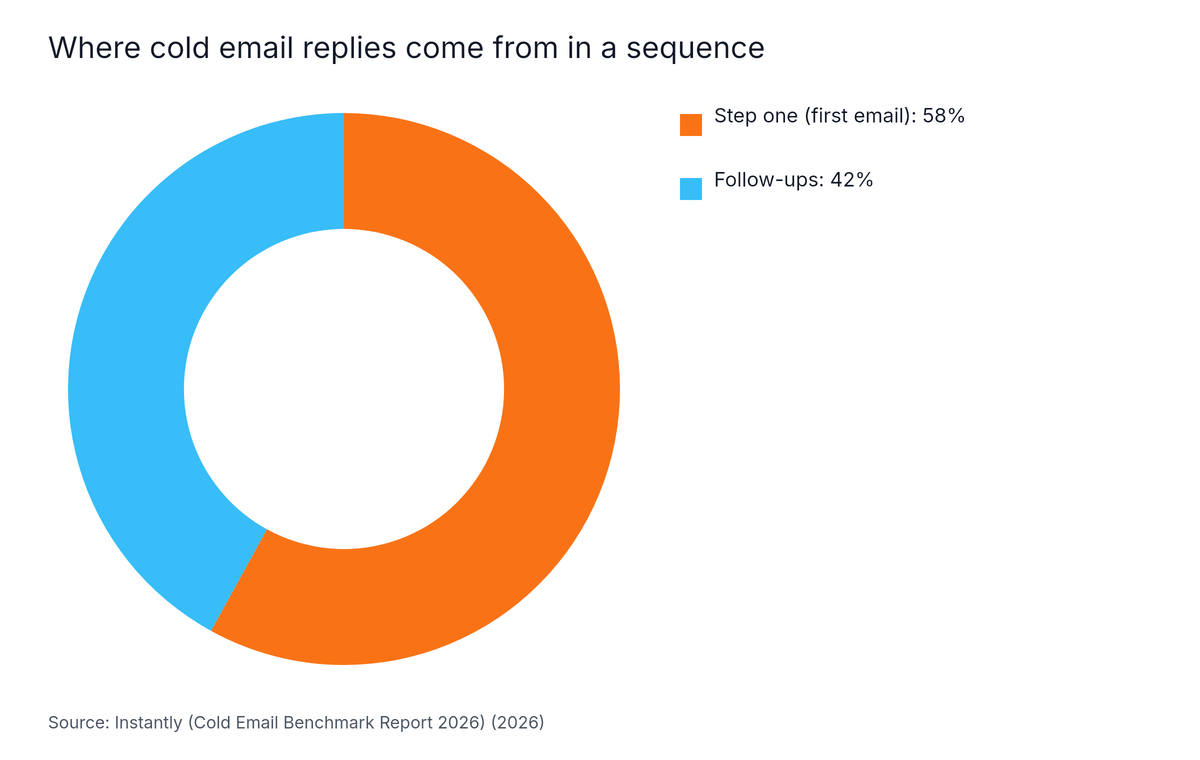
Of cold email replies, 58% come from step one and 42% from follow-ups (Instantly, 2026).
Source: Instantly (Cold Email Benchmark Report 2026), 2026
A goal measured on first sends alone undercounts your work. Set reply goals per sequence, not per email, and give each follow-up a different angle: a new proof point, a short video or a question.
| Metric | Benchmark | Measured against | Source |
|---|---|---|---|
| Cold email reply rate | 3.43% average | Emails sent, all replies including auto-replies | Instantly, 2026 |
| Cold email open rate | 27.7% average | Emails sent | Instantly, 2026 |
| Cold call success rate | 2.7% | Conversations, not dials | Cognism, 2026 |
| Calls to reach a prospect | 1.55 calls | Prospects eventually reached | Cognism, 2026 |
A good cold call success rate for an SDR is around 2.7% of conversations ending in a booked meeting, up from 2.3% in 2025 (Cognism, 2026). Reps also need about 1.55 calls on average to reach a prospect (Cognism, 2026). Set call goals per conversation and per prospect reached, not per dial, because dials hide list quality.
Cold call success rate is the share of cold call conversations that end in a booked meeting. In Cognism's research, the denominator is conversations, not dials. The figure comes from a vendor report using 200,000+ cold calls plus a survey of 15 Chief Revenue Officers and sales leaders in SaaS and IT services (Cognism, 2026). Use it as an anchor, not a law.
Cognism's own phone-first SDR team converted 11.3% of conversations, up from 6.7% the prior year (Cognism, 2026). That is a vendor's self-reported result. It shows the ceiling for a data-driven team, not a typical target.
A practical call plan for a new SDR:
An SDR's goals should rise in stages during ramp, because the average SDR now takes 3.0 months to ramp, the lowest since 2010 and down from a 3.8-month peak in 2014 (The Bridge Group, 2025). Grade month one on activity quality and learning, month two on replies and meetings booked, and only month three on full quota.

Ramp time is the period from a new SDR's start date until they are expected to hit full quota. Companies define "ramped" differently, so write your own definition before you set staged goals.
| Ramp stage | Main focus | Primary goal | Guardrail |
|---|---|---|---|
| Month 1 | Learning the ICP, messaging and tools | Message quality reviewed by a manager | Sequence completion, CRM hygiene |
| Month 2 | Earning replies and conversations | Reply rate and meetings booked | Show rate, list quality |
| Month 3 | Reaching steady state | Meetings held toward full quota | Accepted opportunities |
Because quota attainment is uneven even after ramp, compare each new hire against peers at the same stage, not against the median veteran.
Video prospecting is the use of short personalized videos in outbound email, LinkedIn or SMS to stand out from plain-text messages. It changes goals in two ways: video steps get their own reply and meeting targets, measured against a text baseline such as the 3.43% average reply rate (Instantly, 2026), and recording time is capped so volume does not collapse.

Recording every video by hand limits how many prospects a rep can reach in a day. AI video tools that generate personalized versions from one recording are one way to keep personalization while scaling, and the approach is covered in how to send personalized videos at scale. Add a video step to one sequence first and compare it against a text-only control.
Our data: SendPotion's case study GrowPronto books 45 meetings and closes 7 accounts with Potion reports 45 meetings booked and 7 accounts closed. SendPotion estimates ~15 hours per rep per week saved on manual recording. That figure is the company's own estimate, not independent research.
Independent evidence on AI-assisted outbound is still thin, so set AI-related goals as tests, not targets. A fair test changes one variable, such as AI-drafted research notes or a generated video, holds the list constant and measures replies, meetings held and accepted opportunities. If outcomes do not move, reduce the AI step rather than adding volume. You can generate AI videos in your own face, voice, and gestures at scale to run that test.
No verified source we reviewed shows the SDR role disappearing. Evidence on AI-only outbound is mostly vendor or secondary commentary. Salesforce announced job-ready Agentforce agents on September 11, 2026, including "Hunter", an outbound sales agent, according to a consultancy blog (The KAS Group, 2026). That signals direction, not proven results. Keep humans accountable for outcomes and test AI inside those goals.
SDR benchmarks from The Bridge Group, Instantly and Cognism have limits: most come from vendor platforms or self-reported surveys, each uses its own denominator, and none predicts your result. Cognism's 13.3% answered-call rate is its own team's data, not an industry average (Cognism, 2026). Treat the figures as first-quarter planning anchors, then replace them with your own baseline.
Keep these caveats in view:
Good goals put outcomes first: meetings held, opportunities accepted by account executives and pipeline sourced, with emails sent and dials kept as guardrails. The Bridge Group's 2025 study reports a global median quota of 10 held meetings per month. Pair that with a cold email reply goal near 3.43% (Instantly, 2026) and a call goal near 2.7% of conversations (Cognism, 2026).
The global median SDR quota is 10 held meetings per month, according to The Bridge Group's 2025 report of 351 B2B companies. It varies by model: 16.0 for introductory, 10.4 for semi-qualified and 9.0 for fully qualified motions. Set the number by qualification depth and deal size, not by copying a single benchmark.
A good cold email reply rate in 2026 is near the 3.43% platform average reported by Instantly's 2026 benchmark report, with the top quartile above 5.5%. That average counts all replies per email sent, including auto-replies. Always record which replies you count, so your goal and your results use the same definition.
The average SDR ramp time is 3.0 months, the lowest since 2010, according to The Bridge Group's 2025 research. It peaked at 3.8 months in 2014. Companies define ramped differently, so write your own definition and give new hires staged goals rather than full quota on day one.
About 60% of SDRs are at or above quota, the lowest share in the history of The Bridge Group's study, published in 2025. Most companies, 67%, report that 50-89% of their reps are at quota. Plan capacity assuming part of the team misses, not full attainment from everyone.
A Sales Development Representative (SDR) and a Business Development Representative (BDR) both book meetings for account executives, and many companies use the titles interchangeably. Where firms split them, BDRs usually focus on outbound to new accounts while SDRs also work inbound leads. Check each job description, because definitions differ by company.
No verified source we reviewed shows the SDR role disappearing. Evidence on AI-only outbound is mostly vendor or secondary commentary, such as a consultancy blog's 2026 report of Salesforce's Hunter outbound agent (The KAS Group, 2026). Treat AI as a tool to test inside human-owned goals, and measure meetings held and accepted opportunities.
SDR prospecting works when goals match how buyers actually respond. Start with the outcome, a held meeting that sales accepts, and use activity only to explain why that outcome moved.
Your next step is to build one video step into a live sequence and compare it with a text-only control. Start Free Trial to record once and send personalized video at scale.
Written by
Carlos Agüero
Carlos Agüero builds tools that help B2B sales teams sell smarter. As part of TargetGrid.ai, Skale.email, and Potion, he's focused on multi-channel outreach automation, inbox deliverability, and AI-powered video. Berkeley Haas COBE. Based in Santiago, Chile. Passionate about helping sales teams close more, faster, with less manual work.