Blog
Is Cold Email Legal? US, Canada, UK and Australia Compared
Is cold email legal? Compare CAN-SPAM, CASL, UK PECR and Australia's Spam Act: legal basis, 2026 fines, enforcement cases, footer text and a checklist.

Study the best VSL examples before writing your own. Benchmarks, script structures, and format comparisons for B2B and high-ticket coaching offers.
 Carlos AgüeroOct 13, 2026
Is cold email legal? Compare CAN-SPAM, CASL, UK PECR and Australia's Spam Act: legal basis, 2026 fines, enforcement cases, footer text and a checklist.
What a video landing page for sales outreach should include: five elements, templates by scenario, benchmarks and a QA checklist for SDR teams.
Why AI automation agency cold outreach fails in 2026: benchmark data, deliverability limits, AI SDR results and a six-step workflow that works.
Request a quote and our experts will contact you within 24 hours with tailored solutions and pricing.
You can also send us a quick email at support@sendpotion.com.
Last updated: Oct 13, 2026
By Carlos Agüero - Carlos builds tools that help B2B sales teams sell smarter. As part of Potion, TargetGrid.ai, and Skale.email, he focuses on multi-channel outreach automation and AI-powered video.
A video sales letter (VSL) is a scripted, single-speaker video designed to move a prospect from awareness to a specific conversion action - such as an application, a strategy-call booking, or a direct purchase - in one uninterrupted sitting, without the back-and-forth of a live sales conversation.
If you are building a high-ticket coaching program, a B2B outbound motion, or any offer above $2,000, studying strong VSL examples before you write your own script is one of the highest-leverage things you can do. The format produces measurably higher conversion rates than text-only pages, and the production barrier has dropped dramatically with AI tools. This guide breaks down what makes a VSL work, which format to choose for your offer, how the full funnel operates, and what separates a coaching VSL from a B2B one.
Key Takeaways
- VSL-primary landing pages convert at 12.7% versus 4.8% for text-only pages - a 2.6x lift across 44,000 pages analyzed (Unbounce 2025 Conversion Benchmark Report via Green Frog Labs, 2025).
- High-ticket coaches using a VSL funnel see 15-40% application rates and 60-80% show rates - roughly double the benchmarks for a text-only landing page (Inflo Partners, 2026).
- The three VSL formats - talking-head, slide-deck, and AI avatar - each serve a different price point and production budget. Talking-head builds the most trust for offers above $5,000.
- Cold traffic VSL funnels convert at 0.5-3%; warm or retargeting audiences push that to 2-8% (Blogpros, 2025).
- AI video generation volume grew 840% between January 2024 and January 2026, cutting VSL production time from days to hours for solo operators (Pictory, 2026).
In this guide:
VSL marketing is a direct-response sales strategy that uses a video sales letter - a scripted, single-speaker video - to move a prospect from awareness to a booking or application page, usually in one sitting. It works best for coaches, consultants, and B2B teams selling offers above $2,000, where a buyer needs to be educated and emotionally convinced before they commit.
In 2026, 93% of marketers report positive ROI from video marketing - the highest figure ever recorded in Wyzowl's annual survey history (SociallyIn via Wyzowl, 2025). That headline number reflects broad video adoption, but VSLs occupy a specific, high-leverage corner of it: the direct-response end where the video itself is the sales mechanism, not a supporting asset.
VSL marketing sits at the intersection of direct-response copywriting and video production. The "letter" in video sales letter is intentional: the format borrows the long-form persuasion structure of a direct-mail sales letter and delivers it through video, which removes the friction of reading dense copy and allows tone, pacing, and emphasis to do work that text alone cannot.
VSL marketing is used most effectively by three types of operators:
The adoption numbers back up the breadth of the format. In 2026, 91% of businesses use video as a marketing tool (Wyzowl via Wix, 2026), and 85% of consumers say watching a video convinced them to buy a product or service (Wyzowl via Wix, 2026). VSLs are not a niche tactic. They are the dominant conversion format for anyone selling on the strength of a promise.
VSL marketing is not a brand video, a product demo, or a social-media short. Those formats build awareness or nurture existing relationships. A VSL has a single job: convert a prospect into a qualified lead or a buyer before the video ends. Every structural choice - the hook, the problem statement, the proof, the call-to-action (CTA) - serves that one function.
A video sales letter (VSL) is a structured, persuasion-sequenced video built around a single call-to-action - typically an application, booking, or purchase - while a regular sales video may introduce a brand, showcase a product, or entertain without a hard conversion goal. VSL-primary landing pages convert at 12.7% versus 4.8% for text-only pages, a 2.6x lift across 44,000 landing pages analyzed in the Unbounce 2025 Conversion Benchmark Report (Green Frog Labs, 2025).
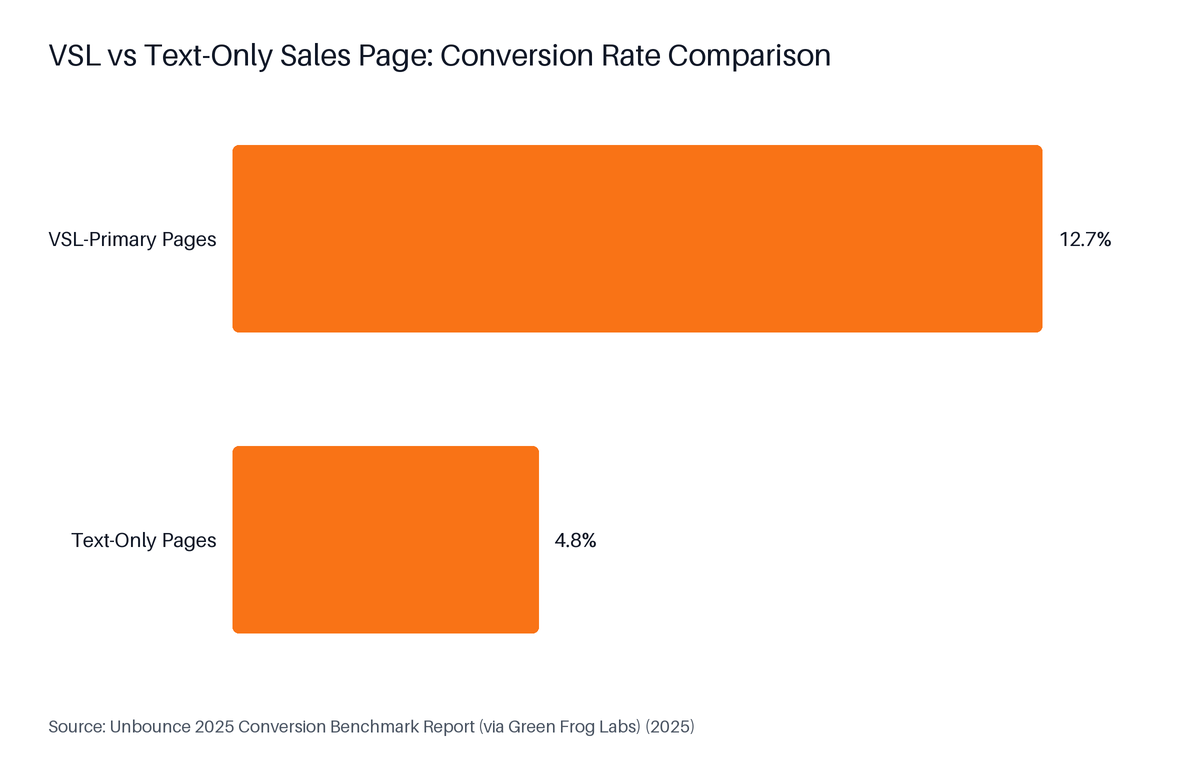
Source: Unbounce 2025 Conversion Benchmark Report (via Green Frog Labs), 2025
The structural difference shows up immediately in how the two formats open. A brand video typically opens with a logo, a company name, or a feel-good montage. A VSL opens with a hook - a statement, question, or claim designed to stop a distracted viewer in the first five to eight seconds. That distinction matters more in 2026 than it did two years ago: overall video engagement is down 7% from 2023, the sharpest drop in four years, driven by rising short-form competition (Wistia 2025 State of Video Report, 2025). A VSL that does not earn attention in the opening seconds wastes every dollar of traffic sent to it.
The right VSL length depends on offer price and audience temperature:
| Offer Price | Recommended Length | Rationale |
|---|---|---|
| Under $500 | 3-8 minutes | Low commitment; buyers decide quickly |
| $500 - $2,000 | 8-15 minutes | Moderate trust-building required |
| $2,000 - $10,000 | 12-20 minutes | High trust; objection handling essential |
| $10,000+ | 15-30 minutes | Maximum pre-call qualification needed |
A 2025 Vidyard analysis of 850 B2B sales videos found that videos between 8 and 15 minutes had the highest engagement-to-conversion ratio (Green Frog Labs, citing Vidyard 2025, 2025). That range aligns with where most high-ticket coaching and B2B VSLs sit.
Wistia's 2025 data shows how-to videos in the 5-30-minute range achieve a 58% engagement rate - the highest of any length category - while videos over 30 minutes fall to 26% (Wistia 2025 State of Video Report, 2025). For VSL creators, this is a practical ceiling: push past 30 minutes and you lose more than a quarter of your remaining audience before the CTA.
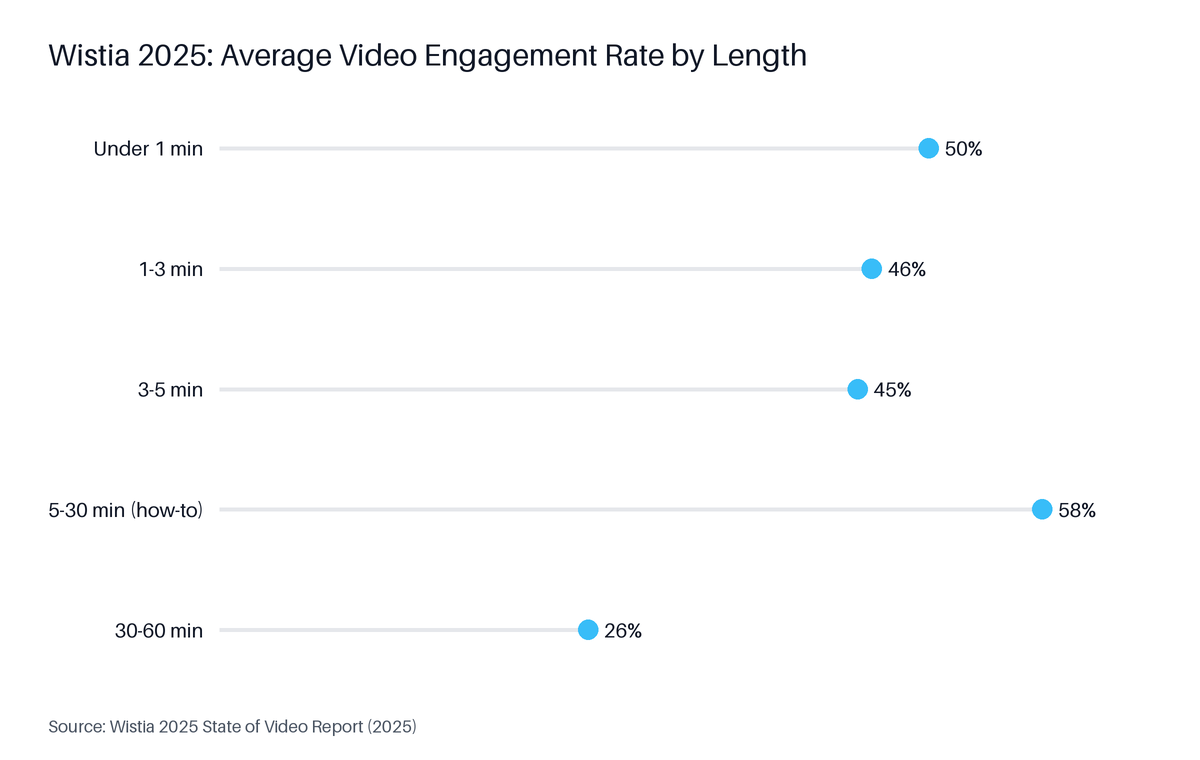
Source: Wistia 2025 State of Video Report, 2025
Every high-converting VSL contains these five components in sequence:
What separates a VSL from a brand or product video is that every section exists to earn the next one. The hook earns the problem section. The problem earns the promise. The proof earns the CTA. Remove any link in that chain and conversion rates fall.
63% of video marketers used AI tools to help create or edit marketing videos in 2026, up from 51% in 2025 (Wyzowl via Wix, 2026). AI has made producing that five-part structure faster, but it has not changed the structure itself. The persuasion logic is unchanged.
A strong video sales letter example for a B2B or coaching offer follows the five-part hook-problem-promise-proof-CTA structure, runs 8 to 15 minutes, and routes viewers to an application page rather than a direct purchase. High-ticket coaches using a VSL funnel see 15-40% application rates and 60-80% show rates, versus 8-12% and 45-55% with a text-only landing page (Inflo Partners, 2026).
As UAbility, which tracks results across 1,400+ coaching clients, puts it: "The VSL is the most effective top-of-funnel mechanism for high ticket coaching and consulting" (UAbility, 2026).
Rather than listing named VSLs that lack verifiable public performance data, this section reverse-engineers the structural choices that make coaching and B2B VSLs work - because those choices are what you can actually replicate.
A typical high-ticket coaching VSL for a $10,000 program follows this pattern:
52% of B2B marketers cite video as the content type generating the highest ROI (Wyzowl via Wix, 2026). For B2B VSLs, the structure is the same - but the proof section shifts from personal transformation stories to named client outcomes, company logos, or quantified pipeline results.
A B2B VSL for a deal in the $15,000 - $50,000 Annual Contract Value (ACV) range adapts the coaching structure with three adjustments:
The underlying persuasion sequence is identical. Only the language register and proof format change.
The three primary VSL formats are the talking-head video, the slide-deck voiceover, and the AI-generated avatar video, and the right choice depends on offer price, production budget, and audience. Talking-head VSLs build the most personal trust and are preferred for offers above $5,000. Slide-deck VSLs suit B2B software or methodology-heavy offers. AI-generated avatar VSLs are the fastest to produce at scale and work well for warm retargeting audiences or personalized outbound sequences.
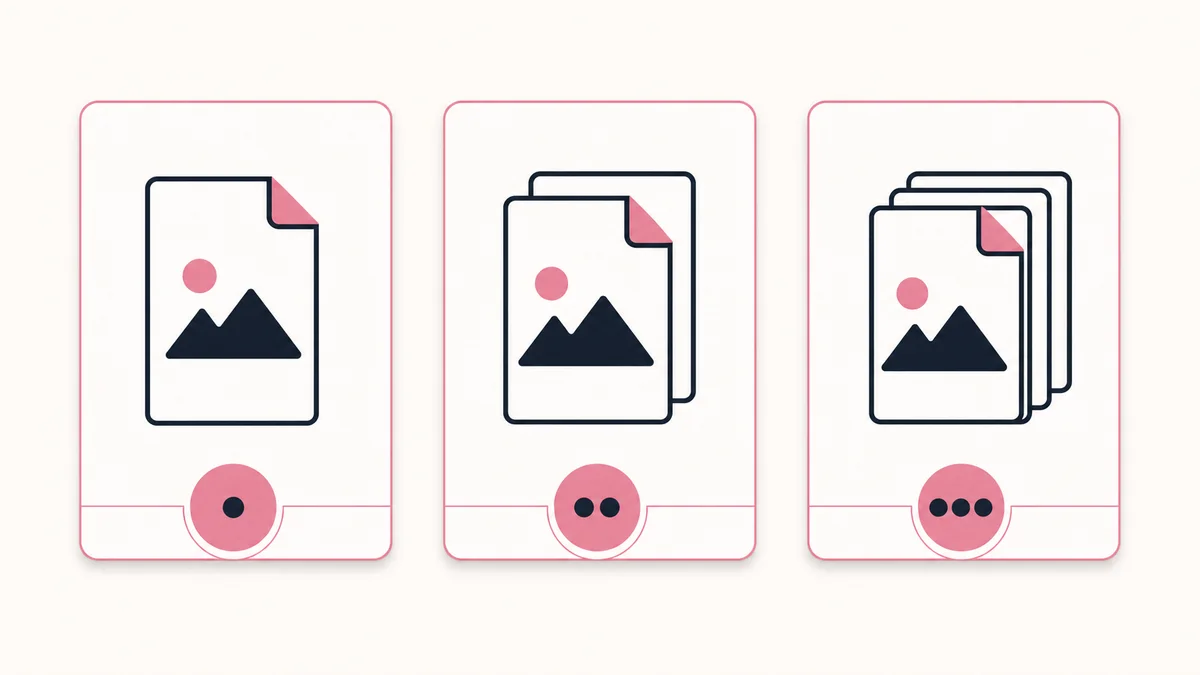
Here is a direct comparison of the three formats across the dimensions that matter most:
| Format | Best For | Production Cost | Trust Level | Scalability |
|---|---|---|---|---|
| Talking-head (on-camera presenter) | High-ticket coaching, personal brand offers above $5K | Low - Medium (smartphone + mic) | Highest | Low (re-record each version) |
| Slide-deck voiceover | B2B SaaS, methodology-driven offers, complex products | Low (screen recorder + script) | Medium | Medium (re-narrate or swap slides) |
| AI-generated avatar | Personalized outbound, warm retargeting, scaled sequences | Low (AI platform subscription) | Medium (improves with rep cloning) | Highest (generate thousands from one recording) |
A talking-head VSL, where the presenter appears on camera for the full video, is the highest-trust format available. For any offer where the buyer is essentially purchasing a relationship - a coaching program, a fractional executive service, a high-end agency retainer - the presenter's face, voice, and mannerisms are part of what the buyer is evaluating. No slide deck replaces that.
The production requirements are lower than most creators assume. A modern smartphone, a $60 USB microphone, a clean background, and good window light produce a watchable talking-head VSL. The script matters more than the camera.
A slide-deck VSL uses a recorded screencast of presentation slides with a voiceover narration. This format works when the core proof of value is a framework, a system, or data - not a personal relationship. B2B software demos and productized services with quantified outcomes convert well in this format.
The disadvantage is that slide-deck VSLs feel more corporate and less personal, which reduces conversion rates for offers where the buyer is purchasing trust in a specific person.
AI-generated avatar VSLs are videos produced using artificial intelligence to clone a presenter's face, voice, and gestures, enabling video creation at scale without repeated on-camera recording sessions. Platforms like Potion (sendpotion.com) let a sales rep or coach record a single master script, then automatically generate thousands of personalized versions - each opening with the viewer's name, company, or a relevant detail - without re-recording.
74% of consumers want AI-personalized video from brands, and consumers are 2x more likely to buy from brands using advanced video technology (Idomoo / Atomik Research 2026 State of Video Technology Report, 2026). For B2B outbound sequences, an AI-personalized VSL thumbnail in a cold email routinely outperforms a generic text sequence.
The format is most effective as a top-of-funnel warm-up: a short (60-90 second) personalized intro video that routes prospects to the full VSL or to an application page. It is not a replacement for a full-length high-ticket coaching VSL.
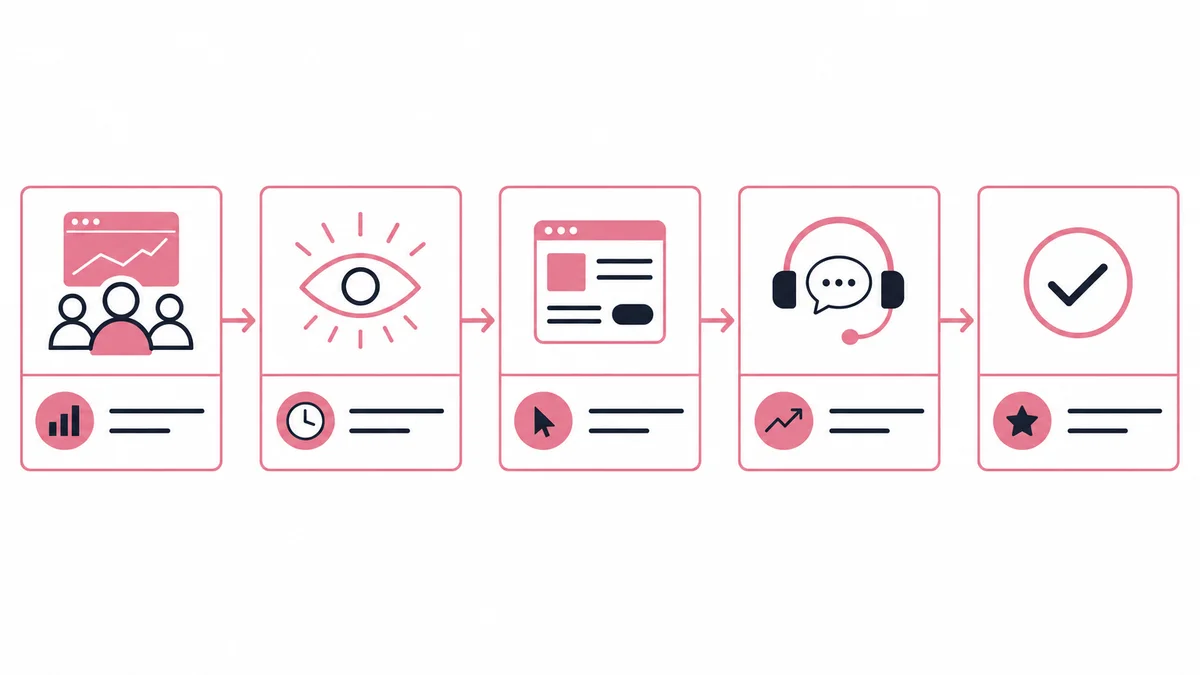
A VSL funnel is a direct-response marketing sequence that moves a prospect through five stages - paid or organic traffic, VSL watch page, application or booking page, strategy call, and close - with each stage filtering for buyer intent. Cold traffic VSL funnels convert at 0.5-3%; warm or retargeting traffic pushes that to 2-8%, per Blogpros (2025). Atomic Funnels' October 2026 data shows VSL-then-book structures outperform direct-to-calendar on show rate and close rate for offers above $5K (Atomic Funnels, 2026).
Here is the full five-stage sequence with realistic benchmarks at each stage:
| Stage | What Happens | Benchmark (warm traffic) |
|---|---|---|
| 1. Traffic | Paid ad, organic search, or email sequence sends prospect to VSL page | - |
| 2. VSL Watch | Prospect watches 50-80% of the video | 40-70% watch rate (warm list) |
| 3. Application / Booking | CTA at end of VSL routes to form or calendar | 15-40% application rate (VSL funnel) |
| 4. Strategy Call | Prospect shows up for a scheduled call | 60-80% show rate (VSL funnel) |
| 5. Close | Call converts to paid client | Varies by offer and sales rep |
For offers priced at $15,000 or above, Atomic Funnels' 2026 benchmark data shows that an application-first funnel - VSL to short qualifying application form to invitation to book a call - outperforms a direct VSL-to-calendar structure on both show rate and close rate (Atomic Funnels, 2026). The application filters out unqualified prospects before they consume a sales rep's calendar, and completing an application increases psychological commitment to the outcome.
The qualifying application typically asks three to five questions:
Answers let the sales rep personalize the strategy call before it begins - which is itself a trust signal that lifts show rates.
The single biggest variable in VSL funnel performance is traffic temperature, not video quality. The same VSL served to cold paid traffic (no prior exposure) converts at 0.5-3%. Served to warm retargeting traffic - video viewers, email list subscribers, social followers - it pushes to 2-8%. This means that optimizing a VSL receiving cold traffic is often less valuable than building a warm-up sequence first. A short personalized video in a cold email sequence can move a prospect from cold to warm, lifting VSL conversion rates meaningfully before they ever reach the watch page.
AI-native VSL production means using artificial intelligence to generate, personalize, or scale video sales letters without a camera crew, studio, or repeated recording sessions. AI video generation volume grew 840% between January 2024 and January 2026, and 58% of AI marketing videos now use AI voiceovers in place of human recordings, according to Pictory's 2026 AI Video Trends report - fundamentally lowering the barrier for solo coaches and small Sales Development Representative (SDR) teams.
Wyzowl's annual surveys show AI tool adoption in video marketing at 18% in 2024, rising to 51% in 2025 and 63% in 2026 (Wyzowl via Wix, 2026) - a near-quadrupling in two years that reflects how quickly AI production has become standard practice for marketers and VSL creators alike.
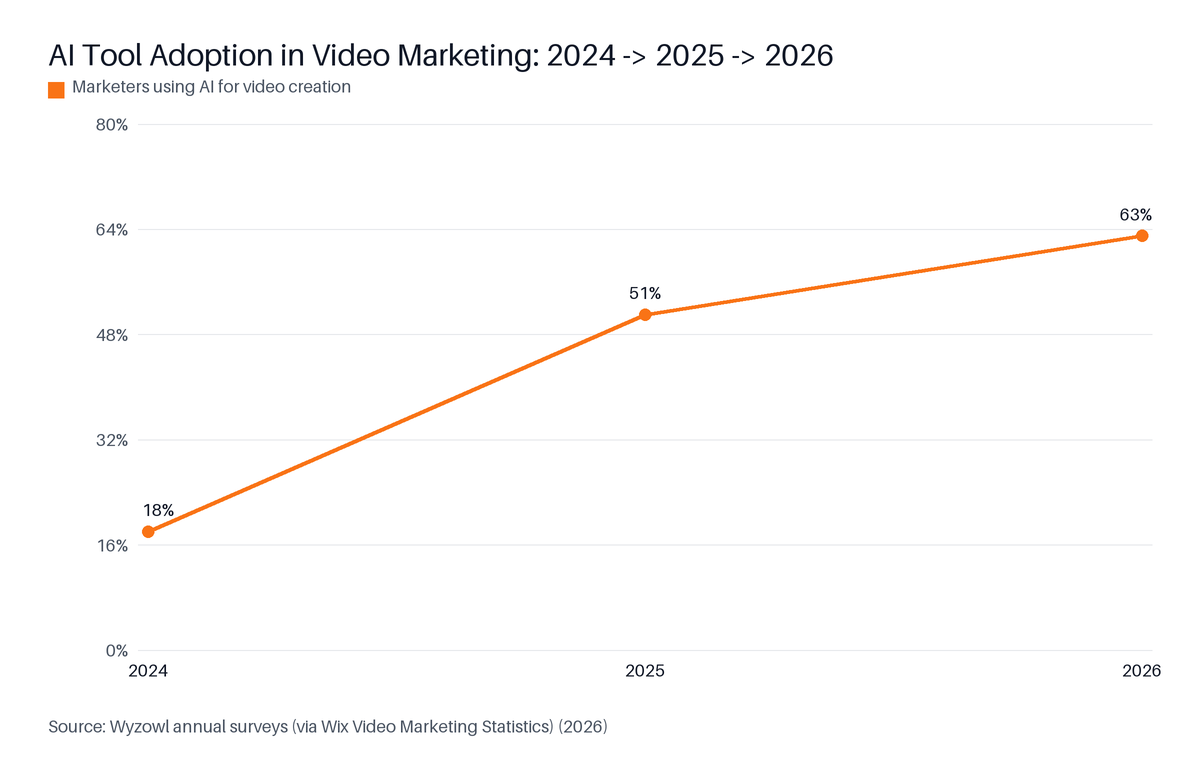
Source: Wyzowl annual surveys (via Wix Video Marketing Statistics), 2026
The practical implications for VSL creators are significant:
Potion (sendpotion.com), an AI-powered video prospecting platform, applies this approach for outbound SDR teams. A rep records one master video, and Potion's AI generates thousands of personalized versions - each with the prospect's name in the greeting, dynamic backgrounds pulled from the prospect's website or LinkedIn, and a CTA linked to the rep's calendar.
Our data: Potion's customer data shows SAP used AI-generated personalized videos to close over USD 500,000 in pipeline. GrowPronto used AI-personalized video outreach to book 45 meetings and close 7 accounts from a single outbound sequence.
The B2B outbound VSL use case and the high-ticket coaching VSL use case are converging. Both now benefit from AI production - coaching for faster iteration and testing, outbound for scale and personalization. The script logic remains the same. The production workflow has changed permanently.
AI production tools remove friction from execution. They do not fix a weak script, a vague promise, or a mismatch between the VSL's message and the traffic source. The 2025 Wistia data showing a 7% year-over-year engagement decline (Wistia 2025 State of Video Report, 2025) is a signal that more video volume is competing for the same viewer attention. AI lowers the cost of producing a VSL. It raises the stakes on the quality of the hook and the specificity of the promise.
A video sales letter is not the right tool for every offer or audience. Cold traffic VSL funnels convert at just 0.5-3% (Blogpros, 2025) - and for the audience segments below, even that floor is optimistic, because the format itself is mismatched to the buyer's decision process.
Specific situations where a VSL is likely the wrong primary tool:
The credibility of knowing when not to use a tool is itself a conversion signal. Sophisticated buyers notice when a coach or vendor recommends a VSL indiscriminately.
A video sales letter rarely closes a $5K - $25K offer entirely on its own. Its job is to pre-sell, qualify, and filter, so that prospects who book a call are already committed to the outcome - and the call closes the deal. Funnel benchmarks from Atomic Funnels (October 2026) show that VSL-then-book structures outperform direct-to-calendar on both show rate and close rate for offers above $5K.
For a high-ticket coaching offer, 8 to 15 minutes is the evidence-supported target. A 2025 Vidyard analysis of 850 B2B sales videos found that 8-15-minute videos produced the highest engagement-to-conversion ratio (Green Frog Labs, citing Vidyard 2025, 2025). Shorter videos rarely build enough trust for a $5K+ offer; longer ones risk losing viewers before the call-to-action.
A video sales letter is a pre-recorded, on-demand video that prospects watch at their own pace, typically 8-20 minutes, designed to move them to an application or booking page. A webinar is a live or evergreen event, usually 60-90 minutes, that builds more social proof and allows real-time Q&A. VSLs convert more traffic to applications faster; webinars are better for cold audiences who need more education before committing.
No. The script and the clarity of the value proposition matter far more than production quality for coaching and B2B offers. A talking-head VSL recorded on a modern smartphone in good light, with clear audio and burned-in captions, outperforms a polished slide-deck video with a weak hook. AI video tools have further lowered the production barrier: 63% of video marketers used AI tools to create or edit marketing videos in 2026, up from 51% in 2025 (Wyzowl via Wix, 2026).
For offers above $5K, leading with price before establishing value almost always increases drop-off. The standard practice is to anchor the outcome and transformation first, mention the investment range near the end of the VSL just before the call-to-action, and let the application or strategy call handle detailed pricing conversations. This is consistent with how most high-ticket VSL funnels are structured.
The most widely used structure for high-ticket coaching VSLs follows five sections: an attention-grabbing hook (first 15-30 seconds), a problem statement that names the viewer's pain precisely, a promise of transformation tied to a specific outcome, proof via case studies or results, and a call-to-action directing viewers to apply or book. B2B VSLs add a credibility section - company logos, compliance signals, or named clients - immediately before the call-to-action.
AI video generation tools now let a solo coach record a single master script once, then automatically produce personalized or localized versions at scale, with voice cloning and dynamic backgrounds. AI video generation volume grew 840% between January 2024 and January 2026, and 58% of AI marketing videos now use AI voiceovers instead of human recordings (Pictory, 2026). This means a solo operator can produce a broadcast-quality VSL without a camera crew or studio.
Video sales letters convert at 12.7% versus 4.8% for text-only pages - and for high-ticket coaching and B2B offers, the gap widens further when the funnel is properly sequenced. The format works because it replicates the logic of a live sales conversation - hook, problem, promise, proof, CTA - and delivers it on demand, at scale, to a qualified audience.
Five things to take from this guide:
Continue learning - the next two topics in this cluster go deeper on the mechanics:
Ready to put a personalized video sales letter in front of your next prospect? Start your free trial at sendpotion.com and generate your first AI-personalized video in under an hour.
Written by
Carlos Agüero
Carlos Agüero builds tools that help B2B sales teams sell smarter. As part of TargetGrid.ai, Skale.email, and Potion, he's focused on multi-channel outreach automation, inbox deliverability, and AI-powered video. Berkeley Haas COBE. Based in Santiago, Chile. Passionate about helping sales teams close more, faster, with less manual work.